Home Blog Page 1784

Appeals court won’t delay block on US military’s transgender ban

PIXABAY

A U.S. appeals court on Monday denied a request by the Trump administration to pause a lower court’s decision blocking President Donald Trump’s ban on transgender people serving in the military.

U.S. District Judge Benjamin Settle in Tacoma, Washington, last week issued a preliminary injunction putting on hold the military’s new policy of identifying and discharging any transgender service members.

The Trump administration appealed Settle’s ruling, and asked the San Francisco-based 9th U.S. Circuit Court of Appeals to put the ruling on hold – which would have allowed it to enforce the ban for now – while the appeal played out.

On Monday, a three-judge panel at the 9th Circuit denied the Trump administration’s request for a so-called administrative stay of Settle’s ruling.

The Defense Department declined to comment. The Justice Department did not immediately respond to a request for comment.

Lambda Legal and the Human Rights Campaign Foundation, two civil rights groups which brought the case on behalf of seven active-duty transgender service members, said in a statement it was pleased the status quo would remain in place while it litigates “on behalf of transgender servicemembers who serve our country selflessly and with distinction and honor.”

In a similar case last week, the U.S. Court of Appeals for the D.C. Circuit issued an administrative stay on a lower court order blocking the transgender ban.

But that court signaled it may quickly reconsider its decision if the military takes action against transgender members.

In his March 27 order, Settle wrote that the military had operated smoothly for four years under a policy allowing transgender people to serve openly.

“Any claimed hardship (the military) may face in the meantime pales in comparison to the hardships imposed on transgender service members,” the judge, an appointee of Republican President George W. Bush, wrote in his decision.

In its request for an administrative stay, lawyers for the Trump administration said Settle substituted his judgment for that of the military.

Absent a stay, the lawyers wrote, “the military will be forced to continue implementing a policy that the Department has determined is not compatible with military readiness and lethality.”

Lawyers with Perkins Coie are among those representing the seven plaintiffs who challenged the transgender ban in the case before Settle.

Perkins Coie is among several prominent law firms Mr. Trump has targeted with executive orders that make it difficult to conduct business.

A judge earlier this month blocked most of that executive order, which would have stripped security clearances from Perkins Coie lawyers and roll back their access to government officials. — Reuters


Kremlin says it’s working on Ukraine peace after Trump says he’s ‘pissed off’ with Putin

A RUSSIAN FLAG flies with the Spasskaya Tower of the Kremlin in the background in Moscow, Russia, Feb. 27, 2019. — REUTERS

MOSCOW/WASHINGTON — The Kremlin said on Monday that Russia and the United States were working on ideas for a possible peace settlement in Ukraine and on building bilateral ties despite U.S. President Donald Trump saying that he was “pissed off” with Vladimir Putin.

Mr. Trump told NBC News he was very angry after the Russian leader criticized the credibility of Ukrainian President Volodymyr Zelenskiy, and the U.S. president suggested he could impose secondary tariffs of 25%-50% on buyers of Russian oil.

Mr. Trump later reiterated to reporters he was disappointed with Mr. Putin but added: “I think we are making progress, step by step.”

Asked about Mr. Trump’s comments, Kremlin spokesman Dmitry Peskov said Moscow was continuing to work with Washington and that Mr. Putin remained open to contacts with Mr. Trump.

“We are continuing to work with the American side, first of all to build our bilateral relations, which were badly damaged during the previous (U.S.) administration,” Mr. Peskov said.

“And we are also working on the implementation of some ideas related to the Ukrainian settlement. This work is underway, but so far there are no specifics that we could or should tell you about. This is a time-consuming process, probably due to its complexity.”

A call between Mr. Trump and Mr. Putin, he said, could be arranged at short notice if necessary, though none was scheduled for this week.

Mr. Trump, who says he wants to be remembered as a peacemaker, has repeatedly said he wants the three-year conflict in Ukraine to end and has warned of the risks of it escalating into a world war between the United States and Russia.

He reiterated on Monday, when speaking to reporters at the White House, that he would impose secondary tariffs if Mr. Putin did not cooperate.

“I want to see him make a deal so that we stop Russian soldiers and Ukrainian soldiers and other people from being killed,” Mr. Trump said in the Oval Office. “I want to make sure that he follows through, and I think he will.”

Finland’s President Alexander Stubb said on Sunday he had told Mr. Trump during a Florida meeting on Saturday that a deadline needs to be set for establishing a Ukraine ceasefire in order to make it happen.

“I came out with an impression that obviously he’s the only person who can broker a peace, a ceasefire, because he’s the only one that Putin is afraid of and in that sense, respects,” Mr. Stubb told Sky News in an interview on Monday.

“We were talking a lot about the ceasefire, the frustrations he had that Russia was not committing to it.”

OIL AND RARE EARTHS
Since taking office in January, Mr. Trump has shifted the U.S. to a more conciliatory stance towards Russia that has left Western allies wary as he tries to broker an end to the war.

His comments about Mr. Putin on Sunday reflect his growing frustration about the lack of movement on a ceasefire.

“If Russia and I are unable to make a deal on stopping the bloodshed in Ukraine, and if I think it was Russia’s fault … I am going to put secondary tariffs on oil, on all oil coming out of Russia,” Mr. Trump told NBC.

“That would be, that if you buy oil from Russia, you can’t do business in the United States,” Mr. Trump said. “There will be a 25% tariff on all oil, a 25- to 50-point tariff on all oil.”

Oil prices were little changed on Monday as traders tried to work out how Mr. Trump’s threat of secondary tariffs against the world’s second largest oil exporter might look.

China and India buy about 80% of Russian crude exports. Chinese traders said they were unfazed by the threat, while Beijing said its cooperation with Russia was neither directed against, nor affected by, third parties. India declined comment.

Amid efforts by Mr. Trump to end the fighting in Ukraine, minerals cooperation has been floated by both Kyiv and Moscow, though Mr. Trump said on Sunday that Zelenskiy wanted to back out of a proposed deal.

Russia and the U.S. have started talks on joint rare earth metals and other projects in Russia, and some companies have already expressed an interest in them, Mr. Putin’s investment envoy, Kirill Dmitriev, said on Monday.

“There are no specifics here yet, but the interest is evident. The interest is mutual because we’re talking about mutually beneficial projects,” Mr. Peskov told reporters. — Reuters

BSP sees March inflation at 1.7%-2.5%

People walk past a market beside the railways in Parañaque City, Metro Manila. — REUTERS

HEADLINE INFLATION likely settled within a range of 1.7% to 2.5% in March, the Bangko Sentral ng Pilipinas (BSP) said on Monday.

If realized, the BSP’s forecast would be slower than the 3.7% inflation print in March 2024.

At the upper end of the BSP forecast, inflation likely accelerated from 2.1% in February.

The low end of the forecast showed inflation may have slowed below 2% for the first time since the 1.9% print in September 2024. It could also mark the slowest inflation since 1.6% in May 2020.

A BusinessWorld poll of 18 analysts conducted last week yielded a median estimate of 2% for the March consumer price index.

March inflation data will be released on April 4.

“Upward price pressures for the month emanate from higher electricity rates and higher prices for fish and meat,” the BSP said in a statement.

In March, Manila Electric Co. (Meralco) raised the overall rate by P0.2639 per kilowatt-hour (kWh) to P12.2901 per kWh from P12.0262 per kWh in February.

The Philippine Statistics Authority said the price of a kilo of round scad (galunggong) averaged P235.26 in early March, slightly higher than the P226.43 in the previous month. The price of fresh pork belly (liempo) rose to P384.08 per kilo in early March from P375.02 a month earlier.

However, the BSP noted there was a drop in prices of rice and vegetables in March.

“Nonetheless, these are expected to be offset by lower prices of rice, fruits, and vegetables, owing to favorable domestic supply conditions as well as the peso appreciation,” it said.

Rice prices have been on a downtrend due to government interventions and lower global prices. In February, rice inflation decreased to 4.9% from the 2.3% drop in January.

The government had slashed tariffs on rice imports to 15% starting July 2024. The Department of Agriculture (DA) declared a food security emergency on rice, which authorized the National Food Authority to release buffer stocks at subsidized prices.

Starting March 1, the DA also further lowered the maximum suggested retail price of 5% broken imported rice to P49 per kilo from P52 per kilo previously. The MRSP was further reduced to P45 per kilo starting March 31.

“Going forward, the Monetary Board will continue to take a measured approach in ensuring price stability conducive to balanced and sustainable growth of the economy and employment,” the BSP said.

The BSP’s baseline forecasts for inflation are at 3.5% for 2025 to 2026. Accounting for risks, inflation could reach 3.7% in 2026.

The BSP last month opted to keep its key rate steady at 5.75% amid global trade uncertainties.

However, BSP Governor Eli M. Remolona, Jr. has said they are still on an easing cycle, signaling the possibility of a 25-basis-point cut at the Monetary Board’s policy-setting meeting on April 10. — A.R.A. Inosante

DA may impose MSRP for imported garlic

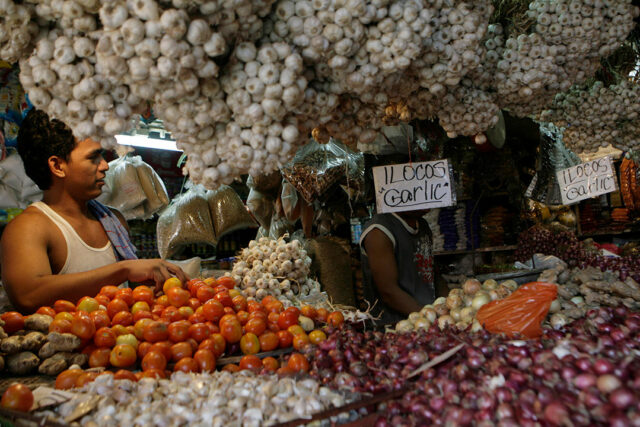
A VENDOR sells garlic and tomatoes at a stall in Taguig in this file photo. — REUTERS

By Justine Irish D. Tabile, Reporter

THE Department of Agriculture (DA) said on Monday that it is looking at imposing a maximum suggested retail price (MSRP) for imported garlic as market prices remain stubbornly high.

“Of course, what we want is to fix this through talks, so we do not have to put an MSRP (on garlic). But if they do not want to follow, we might put an MSRP (on garlic),” Agriculture Secretary Francisco P. Tiu Laurel, Jr. told reporters after inspecting a public market in Quezon City.

The results of the market monitoring on Monday showed that prices of agricultural products such as rice, pork, and fish are going down, but prices of garlic remain elevated.

“The only thing that we are not happy with is the price of garlic. It is a bit expensive as it is being sold at P140-P150 a kilo,” Mr. Laurel said.

“The DA is trying to figure out how to address that and lower its price because it is imported. Ninety-five percent of the garlic in our markets is imported, so we will have to control that,” he added.

According to the Agriculture secretary, importers are selling garlic at P110 per kilo, even though the landed cost is at P80 per kilo.

“The vendor said they bought (garlic) for P110 per kilo. So, if they sell it at P140, they will have a P30 profit. We will check if that P30 per kilo is expensive or not, but I think it is fair,” he said.

“But the garlic importers, their cost is only P80 a kilo, but they sell it for P110 a kilo. And that is if they are declaring the right values, but I know that they sometimes undervalue, so maybe their margin is P40-P50 per kilo. I think that is too much,” he added.

Mr. Laurel said that the DA is just compiling the final figures before calling for a meeting with importers. However, he said he thinks garlic should only be sold at P100-P110 per kilo.

Sought for comment, Samahang Industriya ng Agrikultura (SINAG) Executive Director Jayson H. Cainglet said that only 5% of garlic is locally produced, which is why the group welcomes the proposal to impose MSRP on imported garlic.

“The landed cost of garlic is between P70 and P80 per kilo only, so the retail price should not exceed P130-140 per kilo,” he said in a Viber message.

“If its price exceeds P150 per kilo, it is clear that there is profiteering along the value chain of imported garlic,” he added.

However, Mr. Cainglet said the government has very limited options for short-term interventions, as most garlic is imported.

“One long-term intervention could be the revival of the local garlic industry so that we will have more control over the entire supply chain,” he said.

Federation of Free Farmers  National Director Raul Q. Montemayor said there is rampant profiteering in garlic imports, same as with rice, pork, and other commodities.

“Garlic is being brought into the country at a declared landed price of only P25 per kilo. Its real landed price is about P60 per kilo, and importers declare a lower price so that they end up paying lower tariffs,” he said in a Viber message.

“Even then, the retail price of garlic currently is about P140 per kilo, and sometimes reaches P200 per kilo, indicating huge profit margins. The MSRP may help, but we may have to look for additional ways to control profiteering,” he added.

Mr. Montemayor said the government could use the Price Act or the Anti-Economic Sabotage Law to run after profiteers.

“The longer-term goal is to help our local farmers improve their productivity and output so that they can supply more garlic at a competitive price,” he added.

On the other hand, Philippine Chamber of Agriculture and Food, Inc. (PCAFI) President Danilo V. Fausto said that there is no “unreasonable movement of prices of garlic which requires government intervention.”

“Garlic and onions are of similar nature in the manner of production and price movement. One thing that is important is that we need to encourage more farmers to plant garlic to increase supply,” he said in a Viber message.

For his part, Mr. Laurel said garlic needs temperate weather, which makes it difficult to cultivate garlic in the country.

“Secondly, our planting material, our traditional garlic variety, is small but has a different taste. No one can beat China in the production of garlic in the whole world, so even Thailand, Vietnam, Cambodia, Indonesia, and Taiwan buy from them,” he said.

Mr. Laurel said the DA is also looking at using Korean technology that would boost production to 12-15 tons of garlic per hectare. In the Philippines, farmers produce only about one to two tons of garlic per hectare.

Aside from garlic, Mr. Laurel said that the DA is also monitoring the price of chicken and eggs to see if there is a need to impose a price cap.

The DA is also looking at maintaining the P45 MSRP on rice to ensure that the farmers will have a profit.

“Actually, our initial idea is to lower it further to P42, but with what is happening with our price in the harvest season, it is going down,” he said. “So now, I think it is prudent that we will stop at MSRP P45 for the next two months until the harvest season ends.”

PHL net external liability position narrows at end-Dec.

PHILSTAR FILE PHOTO

THE PHILIPPINES’ international investment position (IIP) stood at a net external liability of $65.5 billion at the end of December, the central bank said.

Bangko Sentral ng Pilipinas (BSP) data showed the net external liability fell by 10.2% at end-December 2024 from the $72.9-billion net liability at end-September 2024.

Year on year, the net external liability position widened by 29% from $50.7 billion in the same period a year ago.

The IIP is an indicator of the value and composition of a country’s financial assets and liabilities. It gauges an economy’s external exposure.

“This development was driven by a 3.4% contraction in the country’s external financial liabilities, which outpaced the 1.4% decline in external financial assets,” the BSP said in a statement.

BSP data showed total outstanding external financial assets fell by 1.4% to $252.7 billion as of end-December from $256.4 billion as of the end-third quarter.

Year on year, it rose by 4.2% from $242.4 billion.

“The country’s total stock of external financial assets contracted mainly on account of the decline in the country’s reserve assets, which stood at $106.3 billion as of end-December 2024 (or a decrease of 5.7% from $112.7 billion as of end-September 2024),” the BSP said.

The central bank also noted that the residents’ net direct investments in debt instruments slid by 2.7% quarter on quarter to $41.8 billion.

Almost half or 43.9% of the external financial assets are held by the BSP, valued at $110.8 billion as of end-December 2024. This was 5.9% lower than the BSP’s $117.8-billion asset holdings at end-September 2024.

“The said development stemmed mainly from the 5.7% decline in the reserve assets, which constitute the majority of the BSP’s external financial holdings,” the BSP said.

Other sectors accounted for 40.9% of the total or $103.4 billion during the same period while banks kept $38.5 billion or 15.2% share.

Meanwhile, total outstanding external financial liabilities dropped by 3.4% to $318.2 billion as of end-December from $329.3 billion at the end of September.

Year on year, it rose by 8.5% from $293.1 billion.

“The country’s total stock of external financial liabilities as of end-December 2024 decreased, primarily due to an 8.2% decline in foreign portfolio investment (FPI) (to $96.3 billion from $104.9 billion) and a 2% decline in foreign direct investment (FDI) (to $129.3 billion from $132 billion),” the BSP said.

The drop in FPI was attributed to the 14.1% decline in nonresidents’ outstanding investments in equity securities of local corporations.

“This mirrored the drop in the Philippine Stock Exchange index (PSEi), which experienced significant declines amid growing concerns over the policies of US President-elect Donald Trump, particularly the proposed import tariff hike that could lead to higher interest rates,” the BSP said.

The PSEi closed at 6,528.79 at the end of December 2024 from 7,272.65 at the end of September 2024.

The BSP also noted outstanding investment in debt securities by nonresidents fell by 3.9% to $58.7 billion as of end-December.

“This decrease was driven by foreign investors’ net selling of their holdings in debt securities issued by the National Government (NG) to residents in the secondary market as well as NG’s and other sectors’ net repayments of debt securities held by nonresidents,” it said.

The BSP also said that net FDI slipped by 2% to $129.3 billion “due to downward valuation adjustments in nonresidents’ net investments in equity capital.”

According to the BSP, other sectors had the biggest share or 58% of the total external financial liabilities, equivalent to $184.6 billion at end-December.

The rest were held by the NG with external financial liabilities of $87.6 billion and banks with $42.2 billion.

The BSP held 1.2% of all external financial liabilities at $3.7 billion, which were mostly in the form of special drawing rights.

Rizal Commercial Banking Corp. Chief Economist Michael L. Ricafort said the narrower net external liability position is partly due to the seasonal increase in debt payments, consistent with a rise in government expenditures and wider budget deficit.

Mr. Ricafort also attributed this to relatively higher interest rates and a weaker peso-dollar exchange rate. — Aubrey Rose A. Inosante

Asia braces for Trump’s reciprocal tariffs to test export model

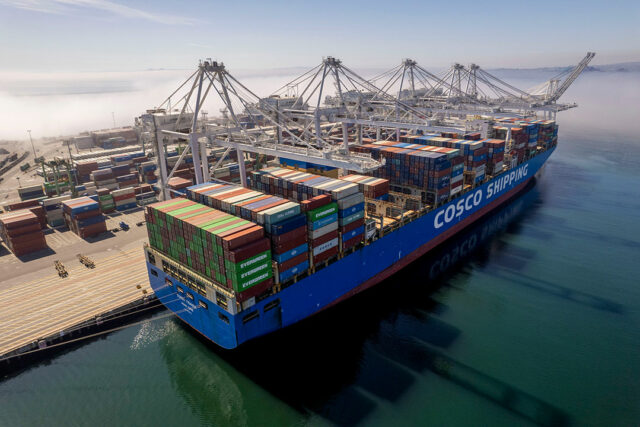
Containers on a Cosco Shipping cargo ship at the Port of Long Beach in Long Beach, California, US. — KYLE GRILLOT/BLOOMBERG

ASIAN LEADERS face tough decisions as President Donald J. Trump’s reciprocal tariffs pose a generational challenge to a region whose economies were built around exports to the US and a world of low trade barriers.

Mr. Trump and his officials have long targeted China and already slapped a 20% levy on imports from the world’s factory floor in a resumption of the trade war unleashed during his first presidency. This time around, he’s also named Vietnam, South Korea, Japan and India as charging onerous tariffs or maintaining outsize trade surpluses — or both.

Treasury Secretary Scott Bessent said in March that the reciprocal levies slated for April 2 will target the “dirty 15” that have substantial trade flows and barriers with the US.

While Mr. Bessent didn’t specify nations, there are exactly that many countries that make up more than three-quarters of the US trade deficit and nine are in Asia, according to a report from Bloomberg Economics. So, it seems reciprocal levies — though cast globally — will hit the region’s $41-trillion economy particularly hard.

Along with Mexico, Canada and the European Union, Asia has been squarely in the sights of Mr. Trump’s protectionist push since his Jan. 20 return to the White House. His 25% tariff on steel imports will hurt Asian producers, which make up six of the 10 biggest shippers of the alloy to the US, and last week’s imposition of 25% tariff on auto imports will dent profits for carmakers including South Korea’s Hyundai Motor Co. and Japan’s Toyota Motor Corp.

The lack of exemptions for US allies, along with tough talk from Mr. Trump and his officials that signals a willingness to accept some near-term economic pain, has rattled markets across the globe. “I couldn’t care less” if foreign carmakers raise prices in response to last week’s tariffs, Mr. Trump said in an interview with NBC News on Saturday.

Now, the addition of reciprocal levies poses a serious threat to Asia’s postwar growth model of export-oriented development, according to Roland Rajah, lead economist at the Lowy Institute think tank.

“This time will be very different” from the Asian crisis in 1998 or the global financial crisis a decade later, Mr. Rajah said from Sydney. Those “were cyclical or financial shocks, but this time this is much more a structural shock,” he added.

GROWTH HIT
Reciprocal tariffs, in addition to those already announced this year, could shave as much as 1.3 percentage points off economic growth in countries across the region, according to economists at Goldman Sachs Group, Inc., largely due to their reliance on direct and indirect US purchases.

Given that dependence on trade with the US, policy makers across Asia are left with few good options. So far, they’ve largely aimed to placate Mr. Trump, shuttling to Washington and promising purchases of goods and lauding the benefits of free trade. Companies have announced new investments in the US, including Hyundai Motor’s $21-billion expansion plan.

“In every capital in Asia — around the world — they’re trying to game out what works with Trump. What works, what doesn’t and what can we offer,” said Wendy Cutler, vice-president at the Asia Society Policy Institute in Washington. “Asian countries are loathe to retaliate.”

Ms. Cutler, who previously spent three decades at the Office of the US Trade Representative, including as acting deputy US trade representative, said countries may also be put off from hitting back following Mr. Trump’s threats to escalate tariffs on Canada after the Northern neighbor threatened retaliation to US levies. 

There are already some signs of a pullback. Manufacturing data show new export orders dropped in February in countries including Indonesia and Vietnam — both nations that benefited from the US trade war with China in 2018-2019. Meanwhile, equity and debt flows to emerging market countries recorded the weakest start to the year since 2016, according to Bank of America.

Asia’s leaders are also taking steps to reduce reliance on the US and bolster their domestic economies.

“If we play our cards right in a very deft and agile way, we can navigate this,” said Marty Natalegawa, Indonesia’s former minister of foreign affairs. “It’s not in our interest to put all eggs in one basket — we must diversify.”

In China, there’s a renewed emphasis on spurring consumption and President Xi Jinping has pledged to open his economy to global companies and resist protectionism. Beijing’s recent pro-business pivot and optimism over advances in artificial intelligence have spurred a rally in Chinese stocks even as Mr. Trump’s trade threats have magnified.

“We should jointly safeguard the free trade system, uphold open regionalism, and firmly oppose trade and investment protectionism,” Ding Xuexiang, the ruling Communist Party’s sixth-ranking official, said during his keynote speech at the annual Boao Forum last week.

Preferential trade agreements in Asia already make up nearly half of those globally, and include the Regional Comprehensive Economic Partnership, the world’s largest free-trade agreement. 

‘SQUEEZE, NOT CHOKE’
There are tentative signs that Mr. Trump’s pressure may spur a deepening of commercial links within Asia. Japan and China held their first economic dialog in six years in Tokyo on March 22, though prospects for a coordinated response to Mr. Trump’s tariffs remains a long way off.

That increased focus on domestic demand and intra-Asian trade may help the region avoid the worst impacts of Mr. Trump’s new levies, according to Louis Kuijs, chief Asia-Pacific economist at S&P Global Ratings. In his second-quarter outlook report, Kuijs said tariffs will “squeeze, not choke” growth across the region. 

However, even if China can spur its economy, it cannot replace the US as a source of final demand. The value of Chinese imports from Asia fell 1% in the first two months of this year, after rising 3.7% last year.

Inu Manak, fellow for trade policy at the Council on Foreign Relations in Washington, said the most lasting impact of the tariffs might actually be felt in the US.

“What I worry about most is US pressure to decouple trade and investment links with China, which forces countries to choose” between the two, with China likely to come out on top, he said. — Bloomberg 

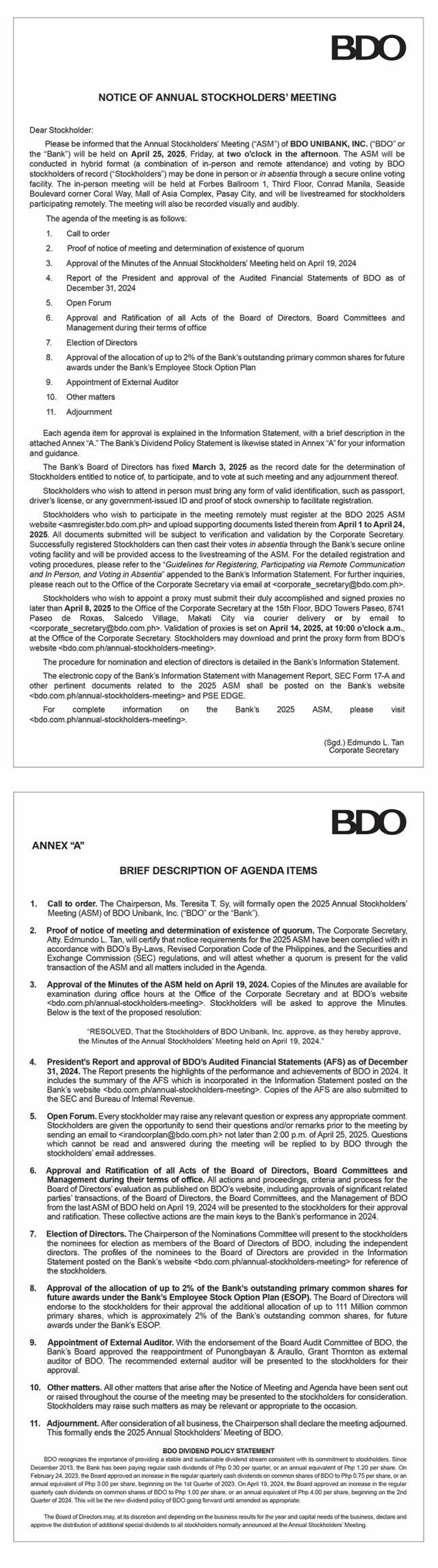
BDO Unibank, Inc.: Notice of 2025 Annual Stockholders’ Meeting (First Publication)

BDO Unibank, Inc. will hold its Annual Stockholders’ Meeting on April 25, 2025, Friday, at 2:00 p.m., at the Forbes Ballroom 1, Third Floor, Conrad Manila, and will be livestreamed for stockholders participating remotely.


Spotlight is BusinessWorld’s sponsored section that allows advertisers to amplify their brand and connect with BusinessWorld’s audience by publishing their stories on the BusinessWorld Web site. For more information, send an email to online@bworldonline.com.

Join us on Viber at https://bit.ly/3hv6bLA to get more updates and subscribe to BusinessWorld’s titles and get exclusive content through www.bworld-x.com.

MPTC seeks to cut debt before listing next year

By Ashley Erika O. Jose, Reporter

METRO PACIFIC Tollways Corp. (MPTC) plans to go public next year after focusing on toll road expansion and debt reduction this year, its top official said.

“We are looking to do an IPO (initial public offering) sometime in the future,” MPTC President and Chief Executive Officer Jose Ma. K. Lim told Money Talks with Cathy Yang on One News on Monday. “It is going to probably take a little more time, maybe the race will be a year from now.”

Preparations for the IPO of Metro Pacific Investments Corp.’s (MPIC) toll arm had started, but the priority now is cutting its debt and completing projects, he added.

“We have some roads to finish,” Mr. Lim said. “The connector road has about two more kilometers to be completed and we also have some access roads to build in Cebu to complement the bridge.”

MPTC has allotted P35 billion for capital expenditures for various projects this year. The Governor’s Drive Interchange of the Cavite-Laguna Expressway (Calax) is among the projects scheduled for completion this year.

Calax is 95% finished, Mr. Lim said, adding that they are building the Cebu access roads to the airport to facilitate more traffic.

In 2024, MPTC said it was negotiating with Acciona SA for the expansion and upgrade of the Cebu-Cordova Link Expressway.

Toby Allan C. Arce, head of sales trading at Globalinks Securities and Stocks, Inc., said the company’s decision to target a 2026 IPO reflects a strategic response to its financial and operational standing.

“This timeline allows MPTC to address its debt obligations and prepare for market entry with stronger valuation,” he said in a Viber message.

But he also cited the uncertainty surrounding the IPO given MPTC’s planned merger with San Miguel Corp. (SMC).

MPTC Chairman Manuel V. Pangilinan said the company had deferred merger talks with San Miguel to focus on fundraising activities to cut its debt. In March, the tollway company said it planned to sell 20% of its stake in MPTC to cut debt.

MPIC, which owns 99.9% of MPTC, earlier said MPTC accounted for most of its P64.99-billion short-term debt and the current portion of its long-term debt as of end-2024.

Mr. Arce said the planned IPO in 2026 would give MPTC the opportunity to strengthen its financial standing but could hurt its merger plans with San Miguel since the parties had also announced a plan to list the merged company.

“If MPTC lists independently before the merger is finalized, it might complicate future integration efforts, particularly in terms of shareholder alignment and regulatory compliance,” he said.

More than awaiting better market conditions, MPTC’s preferred timing is probably to provide a clear market for sister company Maynilad Water Services, Inc., which is also planning to list in the next two quarters, Juan Paolo E. Colet, managing director at China Bank Capital Corp.

“MPTC’s IPO will be a price discovery exercise, so that might affect the sensitive negotiations around the valuation of the proposed merger with San Miguel’s tollway business,” he said in a Viber message.

He added that if MPTC decides to list ahead of its planned merger, San Miguel would likely infuse its tollway assets into the company.

MPIC is one of three key Philippine units of Hong Kong-based First Pacific Co. Ltd., alongside Philex Mining Corp. and PLDT, Inc.

Hastings Holdings, Inc., a unit of PLDT Beneficial Trust Fund subsidiary MediaQuest Holdings, Inc., holds a majority stake in BusinessWorld through the Philippine Star Group, which it controls.

DMCI Homes 2024 net income dragged by weak sales

SATORI RESIDENCES in Pasig City — DMCIHOMES.COM

DMCI PROJECT Developers, Inc.’s (DMCI Homes) net income fell 31% to P2.8 billion in 2024 from a year earlier due to weak sales and fewer project launches.

Excluding one-time gains from land sales, the company posted a 35% decline in core net income to P2.5 billion, DMCI Homes said in a statement on Monday.

“The company recognizes revenue based on construction progress and buyer payments,” it said. “Since it typically takes four to five years before a sale is recorded as revenue, the slowdown in project launches during the pandemic continued to affect the company’s financial performance in 2024.”

DMCI Homes is the property arm of Consunji-led DMCI Holdings, Inc.

Last year was a challenging year for the real estate industry, “but it allowed us to sharpen our focus,” DMCI Homes President Alfredo R. Austria said in the statement.

Unit sales fell 22% due to soft residential demand.

The average selling price per unit rose 18%, while the price per square meter web up 8% on higher construction costs, the shift toward more premium and centrally located developments and the sale of larger units, it said.

DMCI Homes completed 11 buildings last year, from seven buildings in 2023.

“While our selling prices rose year on year due to rising construction costs and a shift toward more premium developments, they remain highly competitive given the quality and value we deliver,” Mr. Austria said.

DMCI Homes said it has seven projects in the pipeline with an estimated sales value of P35 billion. The launch schedule will depend on market demand and conditions.

“We focused our efforts on strengthening our financial position, preparing for future launches and developing new products for underserved markets,” Mr. Austria said. “As the market recovers, we are ready to roll out projects that offer strong value and quality.”

DMCI Holdings stocks gained 0.7% or eight centavos to P11.48 each at the close of trading. — Revin Mikhael D. Ochave

Golden MV earnings soar to P1T due to property valuation gains

PHILSTAR FILE PHOTO

VILLAR-LED property developer Golden MV Holdings, Inc.’s net income surged to P999.72 billion last year from P1.46 billion a year earlier, spurred by fair value gains on its properties.

Fair value gains on investment properties ballooned to P1.33 trillion from P59 million in 2023, the company told the Philippine Stock Exchange in a disclosure.

Revenue dropped 25% to P3.58 billion as real estate sales dropped 26% to P3.31 billion on the back of lower residential unit sales, it added.

Operating profit fell 29% to P1.22 billion on weaker residential sales, while cost and expenses dropped 23% to P2.36 billion.

Total assets rose to P1.37 trillion from P28.64 billion in 2023 due to higher property values. Total liabilities also rose to P355 billion from P14.03 billion due to increased deferred tax liabilities from fair value gains.

In September last year, Golden MV acquired Althorp Land Holdings, Inc., Chalgrove Properties, Inc. and Los Valores Corp., which collectively owns 366 hectares of prime land within the 3,500-hectare Villar City development.

The company earlier said the acquired companies would allow it to concentrate on the development of Villar City, a legacy project of businessman Manuel B. Villar, Jr.

Golden MV also announced in November last year that it would change its corporate name to Villar Land Holdings Corp. to reflect is diversifying business interests.

Villar Land Holdings will use the VLC stock symbol on the local bourse once the name change is finalized.

Golden MV has interests in the development and sale of memorial lots and columbarium facilities. It is also engaged in the residential development business.

Shares of Golden MV fell 2.5% or P60 to P2,340 each. — Revin Mikhael D. Ochave

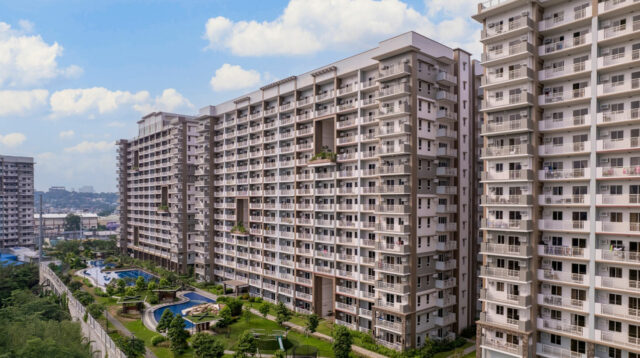
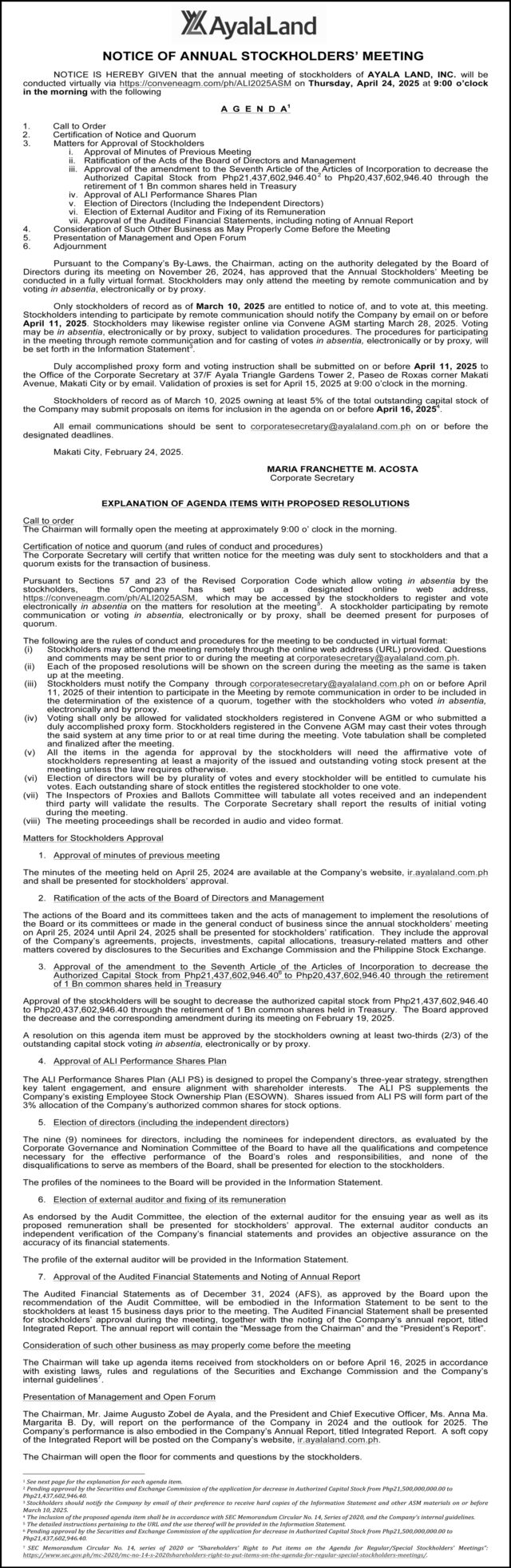
Ayala Land, Inc. sets 2025 Annual Meeting of Stockholders virtually on April 24


Spotlight is BusinessWorld’s sponsored section that allows advertisers to amplify their brand and connect with BusinessWorld’s audience by publishing their stories on the BusinessWorld Web site. For more information, send an email to online@bworldonline.com.

Join us on Viber at https://bit.ly/3hv6bLA to get more updates and subscribe to BusinessWorld’s titles and get exclusive content through www.bworld-x.com.

SC affirms SEC power to accredit external auditors

BW FILE PHOTO

THE SUPREME COURT (SC) has affirmed the power of the Securities and Exchange Commission (SEC) to accredit external auditors of companies that issue registered securities and own secondary licenses, reversing two decisions it issued earlier.

In a resolution promulgated on Jan. 28 and released on Monday, the full court upheld the validity of the rules that enforce Republic Act No. 8799 or the Securities Regulation Code and the revised SEC guidelines on accreditation of auditing firms and external auditors.

The tribunal reversed the rulings it issued in June 2022 and June 2023.

The rules impose accreditation requirements for external auditors of publicly listed companies, investment firms, as well as lending and financing companies, the SEC said in an e-mailed statement on Monday.

The case stemmed from a lawsuit filed by 1Accountants Party-List, Inc., which argued that the additional accreditation requirements restrained certified public accountants (CPA) from practicing their profession.

1Accountants said the SEC exceeded its mandate by issuing the regulations since the supervision, control and regulation of the accountancy profession has been delegated to the Board of Accountancy.

“The SC’s resolution in favor of the SEC reversed earlier findings of invalidity and unconstitutionality of the subject regulations, as the high court emphasized the far-reaching implications of removing such accreditation,” the SEC said in the statement.

The SC said the corporate regulator’s authority to accredit external auditors is implied from its power to supervise the activities of persons, which include juridical and natural persons such as individual auditors of covered entities.

It added that the accreditation requirement applies only to CPAs who are independent auditors of covered entities.

The SC likewise agreed with the SEC’s view that other laws manifest the state’s policy of allowing various regulators, such as those in the financial sector, to accredit external auditors.

“Hence, the SEC’s accreditation of external auditors… is a logical extension of existing regulatory practices aimed at promoting consistency, efficiency and financial integrity across different sectors,” according to the resolution.

“Centralizing the accreditation process under the auspices of the SEC will enhance regulatory oversight, streamline compliance requirements and reinforce investor protection within the securities market ecosystem,” it added. — Revin Mikhael D. Ochave