Home Blog Page 1724

Trump says chips from China will face national security probe; further tariffs expected

 – U.S. President Donald Trump on Sunday bore down on his administration’s latest message that the exclusion of smartphones and computers from his reciprocal tariffs on China will be short-lived, pledging a national security trade investigation into the semiconductor sector.

Those electronics “are just moving to a different Tariff ‘bucket,'” Mr. Trump said in a social media post. “We are taking a look at Semiconductors and the WHOLE ELECTRONICS SUPPLY CHAIN in the upcoming National Security Tariff Investigations.”

The White House had announced the exclusions from steep reciprocal tariffs on Friday.

Mr. Trump’s commerce secretary, Howard Lutnick, earlier on Sunday said that critical technology products from China would face separate new duties along with semiconductors within the next two months.

The exclusions announced on Friday were seen as a big break for technology firms such as Apple and Dell Technologies that rely on imports from China.

Mr. Trump’s back-and-forth on tariffs last week triggered the wildest swings on Wall Street since the COVID pandemic of 2020. The benchmark Standard & Poor’s 500 index .SPX is down more than 10% since Trump took office on January 20.

Mr. Lutnick said Trump would enact “a special focus-type of tariff” on smartphones, computers and other electronics products in a month or two, alongside sectoral tariffs targeting semiconductors and pharmaceuticals. The new duties would fall outside Trump’s so-called reciprocal tariffs, under which levies on Chinese imports climbed to 125% last week, he said.

“He’s saying they’re exempt from the reciprocal tariffs, but they’re included in the semiconductor tariffs, which are coming in probably a month or two,” Mr. Lutnick said in an interview on ABC‘s “This Week,” predicting that the levies would bring production of those products to the United States. “These are things that are national security, that we need to be made in America.”

Beijing increased its own tariffs on U.S. imports to 125% on Friday in response. On Sunday, before Mr. Lutnick’s comments, China said it was evaluating the impact of the exclusions for the technology products implemented late on Friday.

“The bell on a tiger’s neck can only be untied by the person who tied it,” China’s Ministry of Commerce said.

Billionaire investor Bill Ackman, who endorsed Trump’s run for president but who has criticized the tariffs, on Sunday called on him to pause the broad and steep reciprocal tariffs on China for three months, as Trump did for most countries last week.

If Trump paused Chinese tariffs for 90 days and cut them to 10% temporarily, “he would achieve the same objective in causing U.S. businesses to relocate their supply chains from China without the disruption and risk,” Mr. Ackman wrote on X.


‘CHANGES EVERY DAY’

Sven Henrich, founder and lead market strategist for NorthmanTrader, was harshly critical of how the tariff issue was being handled on Sunday.

“Sentiment check: The biggest rally of the year would come on the day Lutnick gets fired,” Mr. Henrich wrote on X. “I suggest the administration figures out who controls the message, whatever it is, as it changes every day. US business can’t plan or invest with the constant back and forth.”

U.S. Senator Elizabeth Warren, a Democrat, criticized the latest revision to Mr. Trump’s tariff plan, which economists have warned could dent economic growth and fuel inflation.

“There is no tariff policy – only chaos and corruption,” Ms. Warren said on ABC’s “This Week,” speaking before Mr. Trump’s latest post on social media.

In a notice to shippers late on Friday, the U.S. Customs and Border Protection agency published a list of tariff codes excluded from the import taxes. It featured 20 product categories, including computers, laptops, disc drives, semiconductor devices, memory chips and flat panel displays.

In an interview on NBC’s “Meet the Press,” White House trade adviser Peter Navarro said the U.S. has opened an invitation to China to negotiate, but he criticized China’s connection to the lethal fentanyl supply chain and did not include it on a list of seven entities – the United Kingdom, the European Union, India, Japan, South Korea, Indonesia and Israel – with which he said the administration was in talks.

Trade Representative Jamieson Greer said on CBS’s “Face the Nation” that there were no plans yet for Trump to speak to Chinese President Xi Jinping on tariffs, accusing China of creating trade friction by responding with levies of its ownBut he expressed hopes for some non-Chinese deals.

“My goal is to get meaningful deals before 90 days, and I think we’re going to be there with several countries in the next few weeks,” Mr. Greer said.

Ray Dalio, the billionaire founder of the world’s biggest hedge fund, told NBC’s “Meet the Press” that he was worried about the United States sliding into recession, or worse, as a result of the tariffs.

“Right now we are at a decision-making point and very close to a recession,” Mr. Dalio said on Sunday. “And I’m worried about something worse than a recession if this isn’t handled well.” – Reuters
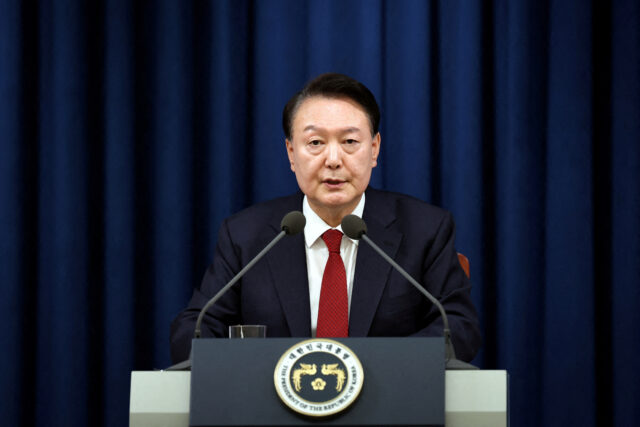
S. Korea begins criminal insurrection trial of ousted president Yoon

South Korean President Yoon Suk Yeol delivers a speech to declare martial law in Seoul, South Korea, December 3, 2024. The Presidential Office/Handout via REUTERS/File Photo

SEOUL — South Korea’s ousted leader Yoon Suk Yeol argued that his brief martial law declaration late last year was “not a coup d’etat” as he appeared in court on Monday for the start of a criminal trial over charges that he led an insurrection.

The martial law attempt, which lasted about six hours before Mr. Yoon backed down in the face of parliamentary opposition and public protests, plunged the country into months of turmoil and led to the Constitutional Court removing him from the presidency this month for violating constitutional powers.

After departing his house in a motorcade on Monday, Mr. Yoon, who has denied all charges against him, entered a courtroom at the Seoul Central District Court, wearing a dark navy suit and red tie.

At the start of proceedings, prosecutors presented their case by arguing Mr. Yoon lacked the legal grounds to declare martial law and accused him of trying to paralyze state institutions such as parliament.

“The defendant … made it impossible for constitutional institutions to exercise their authority based on an unlawful declaration,” the prosecution said.

Mr. Yoon, who was the country’s chief prosecutor before becoming president, spent about 40 minutes in the morning refuting the prosecution’s allegations.

“Martial law is not a coup d’etat,” Mr. Yoon said, adding that he had no intention of paralyzing the country, but that martial law was needed to alert the people to how the majority opposition party was stonewalling government by impeaching more than 20 officials, including the Board of Audit and Inspection chief, which he saw as a dangerous threshold.

“This was a peaceful ‘message martial law’ to the nation… I knew this martial law would end within half-a-day, a day,” Mr. Yoon said.

Mr. Yoon said although he had communicated this intention to ex-defense minister Kim Yong-hyun, military officials carrying out the order seemed to have overstepped it because they are used to  training for martial law under different guidelines.

INSURRECTION CHARGE
Two senior military officers are expected to take the witness stand in the afternoon.

One of them, Cho Sung-hyun from the army’s capital defense command, already testified at the Constitutional Court in February that he was ordered to send troops to “drag” lawmakers out of parliament during Mr. Yoon’s martial law order.

Mr. Yoon denied this allegation.

The martial law declaration, which cited the need to root out “anti-state” elements, was lifted six hours later after parliamentary staffers used barricades and fire extinguishers to ward off special operations soldiers trying to enter parliament, where lawmakers voted to reject martial law.

The charge of insurrection faced by the impeached leader is punishable by life imprisonment or even death, although South Korea has not executed anyone in decades.

Mr. Yoon’s martial law declaration on Dec. 3 shocked South Koreans, and created chaos in all areas of society, the economy and foreign policy, the Constitutional Court said when ruling to remove him from office.

The upheaval has further exposed deep social rifts between conservatives and liberals and stepped up pressure on institutions and the military, which had found itself in a quandary over whether to enforce martial law.

The former president returned to his private home on Friday from the official residence, with crowds of conservative supporters turning out to greet his motorcade.

He remains defiant and has pledged to “stand by” his supporters. The opposition Democratic Party slammed Mr. Yoon on Monday as delusional for not making any sincere apology.

The country will now hold a snap election on June 3. Questions remain over whether Mr. Yoon might still play a role.

Lee Jae-myung, the opposition leader who is leading presidential polls, visited on Monday a startup that develops artificial intelligence (AI) chips, pledging to ease regulations with aggressive investments in the AI industry. — Reuters

Japan PM warns US tariffs have potential to disrupt global economic order

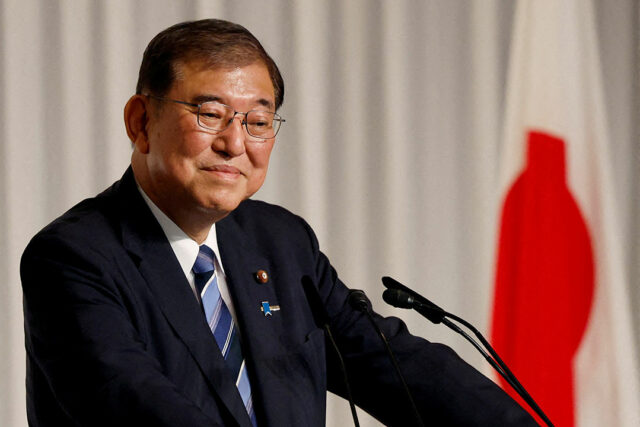
JAPANESE PRIME MINISTER SHIGERU ISHIBA — REUTERS FILE PHOTO

TOKYO — Japanese Prime Minister (PM) Shigeru Ishiba said on Monday that US tariffs have the potential to disrupt the global economic order, issuing his strongest warning to date about the damage President Donald J. Trump’s decisions could inflict on the world economy.

But he stressed that Japan would seek common ground with the United States on how the two countries can cooperate on issues ranging from trade and national security.

“In negotiating with the United States, we need to understand what’s behind Trump’s argument both in terms of the logic and the emotional elements behind his views,” Mr. Ishiba told parliament.

“I am fully aware that what’s happened so far has the potential to disrupt the global economic order,” he said.

Mr. Ishiba also said the government is not thinking of issuing a supplementary budget now but stood ready to act in a timely fashion to cushion the economic blow from US tariffs.

The remarks come ahead of the start of bilateral trade talks on Thursday that are expected to cover themes ranging from tariffs and non-tariff barriers to exchange rates.

In the latest back-and-forth on tariff pronouncements, Mr. Trump said on Sunday that he would be announcing the tariff rate on imported semiconductors over the next week.

Economy Minister Ryosei Akazawa, Japan’s top negotiator on trade talks with the United States, said any discussion on currency rates will be held between Japanese Finance Minister Katsunobu Kato and US Treasury Secretary Scott Bessent.

“Both countries share the view that excessive market volatility would have adverse effects on the economy,” Mr. Kato told the same parliament session. — Reuters

China’s Xi urges stronger trade ties with Vietnam amid US tariff tensions

REUTERS

HANOI/BEIJING — China’s President Xi Jinping on Monday called for stronger ties with Vietnam on trade and supply chains amid disruptions caused by US tariffs, as he kicked off a three-nation trip to Southeast Asia in the Vietnamese capital of Hanoi.

The visit, planned for weeks, comes as Beijing faces 145% US duties, while Vietnam is negotiating a reduction of threatened US tariffs of 46% that would otherwise apply in July after a global moratorium expires.

“There are no winners in trade wars and tariff wars, and protectionism has no way out,” Mr. Xi said in an article in Nhan Dan, the newspaper of Vietnam’s Communist Party, posted ahead of his arrival on Monday.

“The two sides should strengthen cooperation in production and supply chains,” he said, urging more trade and stronger ties with Hanoi on artificial intelligence and the green economy as well.

Under pressure from Washington, Vietnam is tightening controls on some trade with China to make sure goods exported to the United States with a “Made in Vietnam” label have sufficient added value in the country to justify that.

Vietnam is a major industrial and assembling hub in Southeast Asia. It imports most of its goods from China while the United States is its main export market. The country is a crucial source of electronics, shoes and apparel for the United States.

In the first three months of this year Hanoi imported goods worth about $30 billion from Beijing while its exports to Washington amounted to $31.4 billion, Vietnam’s customs data show, confirming a long-term trend in which imports from China closely match the value and swings of exports to Washington.

RAIL LINKS
Mr. Xi will visit Vietnam from April 14 to 15, and Malaysia and Cambodia from April 15 to 18. He last visited Cambodia and Malaysia nine and 12 years ago, respectively.

Mr. Xi’s trip to Hanoi, his second in less than 18 months, aims to consolidate relations with a strategic neighbor that has received billions of dollars of Chinese investments in recent years as China-based manufacturers moved south to avoid tariffs imposed by the first Trump administration.

The two Communist-run countries are set to sign about 40 agreements in multiple sectors, Vietnam’s Deputy Prime Minister Bui Thanh Son said on Saturday.

Vietnam’s top leader To Lam in an article published on Monday on state media said Hanoi wanted to boost cooperation in defense, security and infrastructure, especially on rail links.

It was unclear whether the agreements would be binding and entail financial commitments.

Vietnam has agreed to use Chinese loans to build new railways between the two countries, in a major confidence-building step that would boost bilateral trade and connections.

However, no loan agreement has yet been announced.

Beijing is also seeking Vietnam’s approval for its COMAC planes, which have so far struggled to find foreign buyers.

Despite strong economic ties, tensions frequently surface between the countries over contested boundaries in the South China Sea.

Vietnam’s concessions to the US to avoid tariffs may also irritate Beijing, as they include the deployment of Elon Musk’s Starlink satellite communication service in the Southeast Asian nation, in addition to the crackdown on some trade with China over possible fraud on rules of origin.

Vietnam, in recent months, has also imposed anti-dumping duties on several Chinese steel products and ended a tax waiver for low-value parcels in a move that government officials described as meant to reduce the inflow of cheap Chinese goods.

The two other countries on Mr. Xi’s Southeast Asia itinerary, Cambodia and Malaysia, are facing US duties of 49% and 24%, respectively, and have already begun reaching out to the US to seek a reprieve. — Reuters

Philippines less vulnerable to global trade shocks – Balisacan

PHILIPPINE STAR/WALTER BOLLOZOS

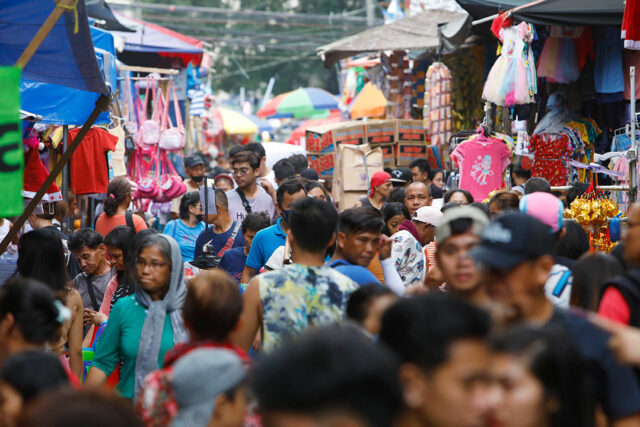
MANILA – The Philippines’ relatively low exposure to trade compared to its Asian neighbours offers a buffer against global economic shocks, National Economic and Development Planning Secretary Arsenio Balisacan said on Monday.

“The economy is not as vulnerable to shocks in the global marketplace as our neighbours… because the Philippine economy’s exposure to trade is fairly small,” Mr. Balisacan told a press conference.

However, he cautioned against complacency, stressing the importance of strengthening export performance by diversifying markets and addressing investment constraints so the country could take advantage of trade diversion opportunities resulting from the sweeping U.S. tariffs.

“We need to double, even triple, our efforts to improve the investment environment so investors see the Philippines as a viable destination,” Mr. Balisacan said.

The Philippines has not been spared from the global trade wars triggered by US President Donald Trump’s tariffs, with Washington threatening levies on Filipino exports.

The Philippines, which already has free-trade agreements with countries such as South Korea and Japan, is actively pursuing a similar pact with the United States to safeguard and expand market access.

Mr. Balisacan said it was premature to revise the country’s economic targets despite the heightened uncertainty. He noted that resilient domestic consumption, which makes up around three-quarters of GDP, should continue to support growth.

He believes hitting the lower end of this year’s 6.0% to 8.0% growth target remains realistic. — Reuters

Beyond tariffs: The case for strategic alliances over bureaucratic quick fixes

By Mon Abrea

The recent imposition of a 17% tariff on Philippine exports by the United States has triggered concern across sectors. While the immediate impact on trade may be evident, the broader question is how the Philippines should respond to such disruptive policies — not with reactive bureaucracy, but with strategic foresight and assertive diplomacy.

The Philippines: More Than Just a Trading Partner

In the midst of rising global protectionism, the Philippines holds a unique and powerful position. As a long-standing treaty ally of the United States and a key player in the Indo-Pacific, the Philippines is not just another trading partner — it is an indispensable strategic partner. Our geographic location, democratic institutions, and military cooperation agreements, including the Visiting Forces Agreement (VFA) and Enhanced Defense Cooperation Agreement (EDCA), reinforce our significance in regional security and global stability.

Economically, US companies remain deeply tied to the Philippines through global supply chains, manufacturing hubs, and business process outsourcing (BPO). These economic interdependencies provide us with leverage — one that should be harnessed wisely to advance our national interest in trade and beyond.

This is not just about tariffs. It’s about reinforcing a strategic alliance in a shifting global order.

The Bureaucracy Trap

In moments of crisis, governments often default to creating new councils or task forces. But more bureaucracy rarely means better solutions. It risks delays, duplications, and political capture.

The Philippines already has capable institutions — the Department of Trade and Industry (DTI), Department of Finance (DoF), National Economic and Development Authority (NEDA), and Department of Foreign Affairs (DFA). What’s needed is not a new layer of governance, but sharper coordination, faster execution, and clearer strategic messaging.

Establishing another body under the Office of the President — especially one composed of select business interests — could unintentionally tilt policy-making in favor of corporate elites. This risks sidelining MSMEs, labor, and the broader public interest.

A Smarter Way Forward

To address global trade disruptions and reinforce economic security, the Philippines must focus on three key strategies:

  1. Strategic Diplomacy

Engage the US at the highest levels, not just through trade representatives. Our role in regional security, democratic resilience, and supply chain continuity should be central to our messaging.

  1. ASEAN Solidarity

Protectionism undermines regional cohesion. By rallying ASEAN partners to take a united stand, the Philippines can amplify its voice and promote multilateral, rules-based trade engagement.

  1. Institutional Agility

Instead of reinventing structures, strengthen existing ones. Mobilize interagency task forces, streamline trade responses, and ensure inclusive consultations — not dominated by corporate lobbyists, but reflective of national interests.

Turning a Tariff into an Opportunity

This 17% US tariff is more than a trade obstacle — it’s a timely reminder for the Philippines to rethink its strategic posture. The response must be agile, inclusive, and internationally informed.

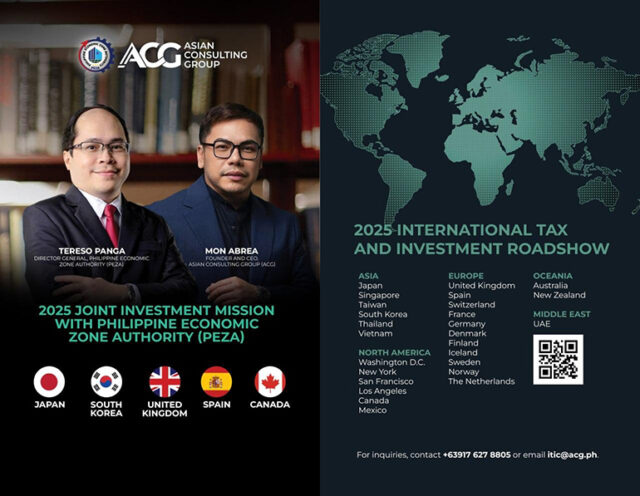
As we continue our international tax and investment roadshow across Asia, Australia, the Middle East, Europe, Canada, and the United States, we are engaging global investors and institutions with one message: the Philippines remains a strategic and sustainable investment destination — now more than ever.

In moments of global uncertainty, it’s not the loudest bureaucracy that leads — it’s the most strategic nation that prevails.

Mon Abrea, CPA, MBA, MPA is the Founder and CEO of the Asian Consulting Group (ACG) and the Philippines’ foremost advocate of genuine tax reform. A Harvard graduate who also completed an executive program on Climate Policy at Oxford, he advises governments, multinational corporations, and global institutions on tax policy, governance, and sustainable investment. He has delivered investment and tax briefings in over 50 countries and states across Asia, North America, Europe, Australia, and the Middle East. He also hosts the podcast Thought Leaders and Game Changers, where he speaks with global experts on taxation, sustainability, and innovation. Follow him: @askthetaxwhiz.


Spotlight is BusinessWorld’s sponsored section that allows advertisers to amplify their brand and connect with BusinessWorld’s audience by publishing their stories on the BusinessWorld Web site. For more information, send an email to online@bworldonline.com.

Join us on Viber at https://bit.ly/3hv6bLA to get more updates and subscribe to BusinessWorld’s titles and get exclusive content through www.bworld-x.com.

Online mystery boxes: Are they worth it? What you need to know before buying

(This article is a paid content published on Spotlight, BusinessWorld’s sponsored section, and therefore does not reflect BusinessWorld’s views on the matter. The editorial staff is not involved in its creation. BusinessWorld does not have any legal liability on any decisions derived from reading advertisements published on its platforms. Readers are advised to thoroughly research and understand potential risks before availing products or services.)

Online mystery boxes have become very popular. Many people love the excitement of opening a box without knowing what is inside. These boxes may contain gadgets like smartphones, headphones, gaming consoles, or smartwatches. But are they really worth the money?

Before you buy an online mystery box, it’s important to understand the risks. Some mystery boxes give great value, but others can be disappointing. Some even turn out to be scams.

What Are Online Mystery Boxes?

An online mystery box is a package you buy without knowing what’s inside. It can contain random items, sometimes of high value, but sometimes just cheap accessories. Many online stores sell mystery boxes with the promise of big rewards.

Some companies claim that their boxes include high-end products like:
✔ Latest iPhones or Android phones
✔ PlayStation, Xbox, or Nintendo Switch
✔ Smartwatches and earbuds
✔ Laptops or tablets

While these offers sound tempting, there is always a risk. Some buyers end up with expensive gadgets, while others receive cheap, low-quality items.

Why Do People Buy Online Mystery Boxes?

The main reason people buy mystery boxes is excitement. The idea of getting a high-end gadget for a lower price is very attractive.

Other reasons include:

  • Surprise Factor – People love surprises and the thrill of opening a mystery package.
  • Possibility of Big Wins – Some boxes contain very expensive items, making buyers hope they will get lucky.
  • Trying Something New – It’s an easy way to discover new gadgets without choosing them.
  • Gift Idea – Mystery boxes are often given as gifts to family and friends.

However, mystery boxes don’t always give great value, which is why buyers should be careful.

The Risks of Buying Online Mystery Boxes

Not all mystery boxes are created equal. Some are fair and transparent, while others trick buyers into losing money. Here are the main risks you should know before buying one:

1. Low-Value Items

Many online mystery boxes promise expensive gadgets, but most people receive cheap or outdated items. For example, instead of a new smartphone, you might get a phone case or old charger.

2. Fake Promises

Some websites claim they offer high-end products, but they never actually include them in their mystery boxes. If you check reviews, you may find that no one has ever received a premium item.

3. Scam Websites

There are many scam websites that sell mystery boxes but never deliver the product. These sites take your money and disappear. That’s why it’s important to buy from trusted platforms.

4. No Refunds

Most mystery box sellers have a no-refund policy. This means that if you get a low-value item, you cannot return it. Once you buy the box, your money is gone.

5. Randomized Odds

Mystery boxes work like a lottery. The chance of getting a premium item is usually very low. Some websites do not explain the odds clearly, making buyers think they have a better chance than they really do.

How to Avoid Getting Scammed

Even though there are risks, you can still enjoy online mystery boxes if you buy from the right platform. Here’s how to stay safe when purchasing a mystery box:

  • Research the Seller – Check reviews on Trustpilot, Reddit, or forums to see what real customers say.
  • Read the Terms & Conditions – Avoid websites with unclear refund policies or vague descriptions.
  • Look for Transparency – Reliable platforms show actual odds and explain how their system works.
  • Check Payment Methods – Use secure payment options like PayPal or credit cards that offer protection.
  • Be Realistic – If a deal seems too good to be true, it probably is.

By following these tips, you can reduce the chances of losing money.

Is There a Safer Way to Buy Online Mystery Boxes?

Yes! While many mystery box websites lack transparency, there are platforms that offer a fair system for buyers.

Some websites provide clear odds, guaranteed value, and reliable shipping, making them a better choice for those who want to try their luck. Jemlit is one of the legit platforms where buyers can get real products instead of cheap fillers or scams.

If you’re interested in mystery boxes, always do your research and choose platforms that have positive reviews and fair policies to avoid disappointment.

Are Online Mystery Boxes Worth It?

Online mystery boxes can be fun, but they also come with risks. Some people get amazing deals, while others lose money. Before buying, always research the seller, check reviews, and read the fine print.

If you want to enjoy the excitement without the risk of scams, it’s best to choose a trusted platform like Jemlit, where you have clear odds and guaranteed value.

So, are online mystery boxes worth it? The answer depends on where you buy them and how much risk you are willing to take. If you go in with the right expectations and use a safe platform, they can be an exciting way to discover new gadgets.


Spotlight is BusinessWorld’s sponsored section that allows advertisers to amplify their brand and connect with BusinessWorld’s audience by publishing their stories on the BusinessWorld Web site. For more information, send an email to online@bworldonline.com.

Join us on Viber at https://bit.ly/3hv6bLA to get more updates and subscribe to BusinessWorld’s titles and get exclusive content through www.bworld-x.com.

Philippines says voiced South China Sea concerns during ASEAN-China negotiations

PHILIPPINE COAST GUARD/HANDOUT VIA REUTERS

MANILA – The Philippines voiced concerns on the South China Sea, including incidents that endangered its vessels and personnel, during negotiations between ASEAN and China for a code of conduct in those waters, its foreign ministry said on Monday.

The Philippines, which hosted the latest round of talks last week, also reiterated its commitment to resolving disputes peacefully and pursuing constructive diplomatic approaches in managing differences at sea, the ministry said in a statement.

The South China Sea remains a source of tension between China and its Southeast Asian neighbors, with ties between Beijing and U.S. ally Manila at their worst in years amid frequent confrontations that have sparked concerns they could spiral into conflict.

In February, the Philippines coast guard accused the Chinese navy of performing dangerous flight maneuvers near a government aircraft patrolling a disputed shoal in the South China Sea, an account Beijing disputed.

The Association of Southeast Asian Nations and China pledged in 2002 to create a code of conduct, but it took 15 years to start discussions, and progress has been slow.

During the negotiations from April 9-11, the countries also tackled so-called “milestone issues,” the Philippines’ foreign ministry said. These issues refer to critical points, including the code’s scope and whether it can be legally binding.

Beijing claims sovereignty over most of the South China Sea, which it asserts through a fleet of coast guard and fishing militia that some neighbors accuse of aggression and of disrupting fishing and energy activities in their exclusive economic zones.

China insists it operates lawfully in its territory and does not recognize a 2016 arbitration ruling that said its claim has no basis under international law.

“The meeting was an opportunity for the Philippines to strongly call for the need to adhere to international law, particularly the UN Convention on the Law of the Sea, and the 2016 South China Sea Arbitral Award,” the ministry said. — Reuters

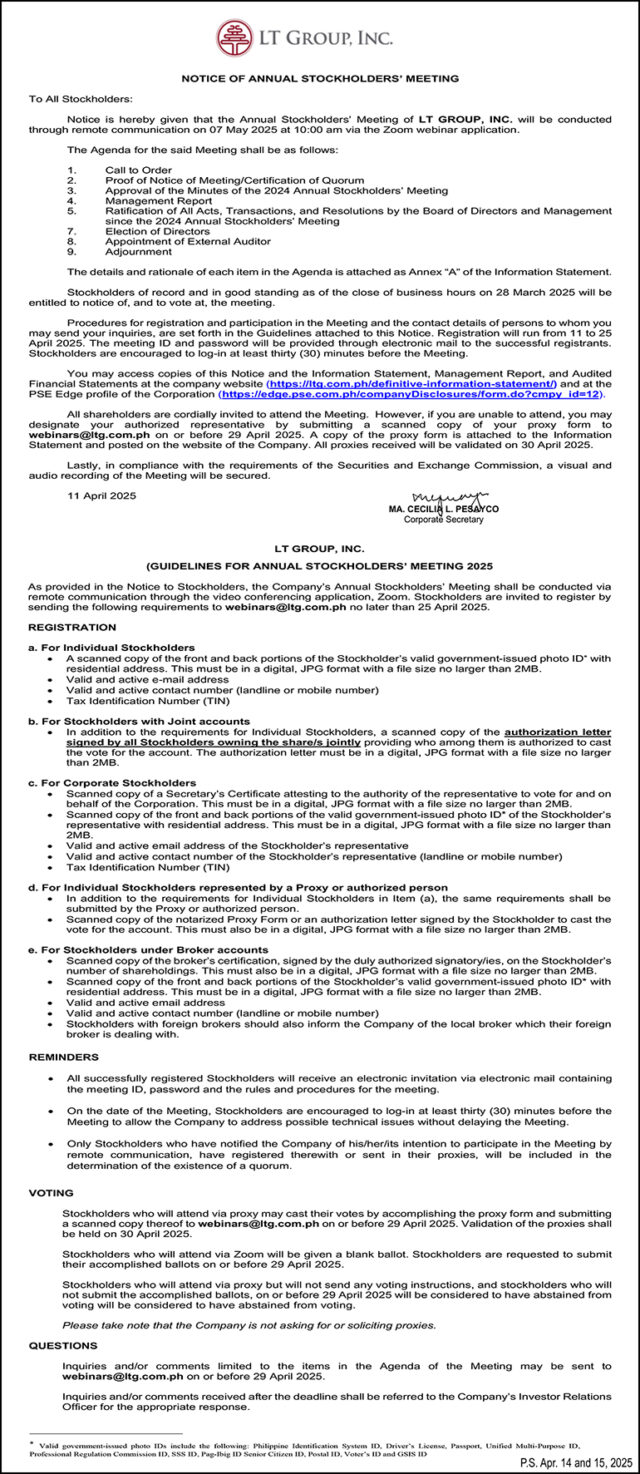
LT Group, Inc. to convene for Annual Meeting of Stockholders on May 7 via Zoom


Spotlight is BusinessWorld’s sponsored section that allows advertisers to amplify their brand and connect with BusinessWorld’s audience by publishing their stories on the BusinessWorld Web site. For more information, send an email to online@bworldonline.com.

Join us on Viber at https://bit.ly/3hv6bLA to get more updates and subscribe to BusinessWorld’s titles and get exclusive content through www.bworld-x.com.

Indian shrimp industry sails in troubled waters after Trump tariffs

STOCK PHOTO | Image by magdus from Pixabay

 – Turbulence unleashed by President Donald Trump’s tariffs could rock global shipments of shrimp to the United States, with exporters in biggest supplier India saying they endanger 2,000 containers packed with the frozen delicacy.

But Ecuador, thousands of kilometers nearer to the United States faces a lower tariff rate and stands to benefit, the exporters say, as shrimp is its most important export after oil.

India’s shrimp industry is staring at a tariff of 26% under Trump’s July plan, which threatens a thriving $7-billion seafood export market heavily reliant on U.S. supermarket chains such as Walmart and Kroger as buyers look to renegotiate rates.

Farmers are seeing demand dry up amid the uncertainty as exporters have cut offer prices by a tenth since the tariffs.

“We are suffering huge losses,” said S.V.L. Pathi Raju, 63, standing by the aquaculture pond where he feeds and grows shrimp in India’s southern coastal state of Andhra Pradesh.

“We don’t know who can resolve our price issues,” added Raju, one of several families in the state’s remote village of Ganapavaram grappling with dwindling sales to exporters.

Many also face high payments for shrimp feed and rentals for the land where the saline ponds have been set up.

“I am not sure how I will sustain prices,” said another farmer, 60-year-old Uppalapati Nagaraju, adding that he had been entirely unaware of the concept of tariffs.

“Had I known, I would not have started my cultivation.”

In the face of erratic demand from exporters, he now regrets having begun shrimp cultivation just 15 days before the tariff news. Although Trump has delayed the 26% rate until July, even the current rate of 10% has made exporters skittish.

The United States and China are among India’s major markets for seafood exports that touched $7.3 billion last year, on a volume of 1.8 million metric tons that was an all-time high.

Shrimp formed the major component, with the 300,000 farmers of Andhra Pradesh contributing the most to industry supplies, accounting for 92% of India’s seafood exports of $2.5 billion last year to its biggest market, the United States.

Industry representatives have joined a state government panel weighing the impact of tariffs and looking for ways to boost exports to other countries, such as China.

But the exporters fear Ecuador’s competitive edge from Trump’s planned lower tariff rate of 10% for the South American nation, particularly since it is much closer to the United States, its second biggest market for shrimp.

Yet Ecuadorean producers, with $1.55 billion in shipments in 2024, are less optimistic.

Although U.S. consumers have fueled growth in the area of processed shrimp, Ecuador has yet to attain the capacity to replace India’s production, said Jose Antonio Camposano, president of its National Chamber of Aquaculture.

India “will be obliged to look for other markets where Ecuador is selling, like China and the European Union, so we’ll have more pressure in other markets,” Mr. Camposano added.


JOURNEY OF 40 DAYS

Reuters visited one Indian factory where shrimp was washed and machine sorted automatically by size before a manual quality check by workers in masks and gloves. Then a conveyor belt whisked the seafood away to be quick-frozen.

Thousands of tons of frozen shrimp leave Andhra Pradesh each year on a voyage that usually takes 40 days to arrive at ports in New York, Houston and Miami, en route to restaurants and the shelves of retailers such as Safeway and Costco.

The chief of India’s seafood exporters group, G. Pawan Kumar, said he was worried about shipping containers already packed with frozen produce at previously agreed rates now set to be renegotiated by U.S. buyers following the tariffs.

“Ten percent is high, we exporters operate on a 3% to 4% margin,” said Kumar, president of the Seafood Exporters Association of India, which is pushing the government to win the industry exemptions in trade talks with the United States.

“It’s game over” for the Indian industry if the tariff rate of 26% takes effect in July, said one shrimp exporter, who spoke on condition of anonymity.

He was in talks with U.S. clients who did not want to fully absorb the 10% tariff, he said, pointing to the risk of earning no profit if he had to sell 130 shipping containers already packed.

In Texas, the seafood section at a Walmart supermarket was piled high with packs of frozen shrimp, among them a “jumbo” variant labelled a product of India and priced at $7.92, under Walmart’s own “Great Value” brand.

“We have built long-lasting and deep relations with suppliers over the years,” said Latriece Watkins, the chief merchandising officer for Walmart in the United States. “We expect that to continue, going forward.” – Reuters

NTC activates nationwide Holy Week 2025 public assistance operations

The National Telecommunications Commission (NTC) officially activated its annual nationwide public assistance operations for the HOLY WEEK 2025, directing all Regional Directors to coordinate with the National Disaster Risk Reductions and Management Councils (NDRRMCs), Civic Action Groups (CAGs) and Amateur Radio Groups (ARGs) that will render public assistance operations within their respective areas of jurisdiction and extend assistance to the LGUs and NDRRMC.

In a Memorandum dated April 7, 2025, all Regional Directors were instructed to determine the appropriate assistance the Commission may provide, such as issuance of the necessary temporary permits and licenses, to lend assistance and ensure the safety of our kababayans who will be traveling to various parts of the country.

The assistance of radio, television and cable TV stations/operators have also been enlisted for the proper and timely dissemination of related information.

The preparatory reports to be submitted to the Office of the Commissioner contain the list of participating CAGs and ARGs, the areas and routes covered, operating frequencies and contact details of point persons for the duration of the operations.

The Regional Offices are also directed to monitor the operations of the CAGs and ARGs in their areas of jurisdiction and submit ongoing and post-operation reports to the Office of the Commissioner.

This annual public service activity organized by the NTC and its Regional Offices aims to ensure the safe travels of Filipino families during their traditional pilgrimage to the provinces during Holy Week.


Spotlight is BusinessWorld’s sponsored section that allows advertisers to amplify their brand and connect with BusinessWorld’s audience by publishing their stories on the BusinessWorld Web site. For more information, send an email to online@bworldonline.com.

Join us on Viber at https://bit.ly/3hv6bLA to get more updates and subscribe to BusinessWorld’s titles and get exclusive content through www.bworld-x.com.

Russian missile strike kills 34 in Ukraine’s Sumy, Kyiv says

UKRAINE and Russian flags are seen through broken glass in this illustration taken March 1, 2022. — REUTERS

 – Two Russian ballistic missiles slammed into the heart of the northern Ukrainian city of Sumy on Sunday, killing 34 people and wounding 117 in the deadliest strike on Ukraine this year, officials said.

President Volodymyr Zelenskiy demanded a tough international response against Moscow over the attack, which came with U.S. President Donald Trump’s push to rapidly end the war struggling to make a breakthrough.

Dead bodies were strewn on the ground in the middle of a city street near a destroyed bus and burnt-out cars in a video posted by Mr. Zelenskiy on social media.

“Only scoundrels can act like this, taking the lives of ordinary people,” he said, noting that the attack had come on Palm Sunday when some people were going to church.

“You know, the people who are fighting against us always say that they are Orthodox (Christian) believers, that they believe in God, but we have experienced first-hand terrorism today. I have no words,” said 27-year old PhD student Yevhen, a local resident who declined to give his surname.

The leaders of Britain, Germany and Italy condemned the attack.

“These attacks show just what Russia’s supposed readiness for peace is worth,” German Chancellor Olaf Scholz wrote on social media.

U.S. Secretary of State Marco Rubio in a statement expressed condolences for the victims and said the attack was a “tragic reminder of why President Trump and his Administration are putting so much time and effort into trying to end this war.”

Mr. Zelenskiy, in an interview with CBS News’ “60 Minutes” aired on Sunday, urged Trump to visit Ukraine.

“Please come to see people, civilians, warriors, hospitals, churches, children, destroyed or dead,” Mr. Zelenskiy said in a video clip the program posted on social media.

During the interview, which took place on Friday, Mr. Zelenskiy was asked if the United States had Ukraine’s back.

After a brief pause, Mr. Zelenskiy replied: “Even in this pause of mine, there’s a problem, because I want to answer truthfully and quickly that the United States is our strategic, strong partner,” he said. “But the pause is doubt. I don’t doubt that the people of America are with us, but in a long war, many details are forgotten.”

He called on the United States to provide forces as part of an international peacekeeping effort, specifically asking for Washington to help protect Ukrainian airspace with aircraft.

Under Trump’s administration, U.S. officials have held separate rounds of talks with Kremlin and Kyiv officials to try to move toward a cessation of hostilities in Ukraine.

Russian authorities did not immediately respond to a Reuters request for comment. Russia denies targeting civilians but thousands have been killed and injured in its invasion of Ukraine.

A separate Russian drone attack injured five people in the Black Sea port city of Odesa late on Sunday and damaged a medical facility, regional officials said.

The Sunday attacks followed a missile strike in the central Ukrainian city of Kryvyi Rih, Mr. Zelenskiy’s hometown and far from the ground war’s front lines in the east and south, this month that killed 20 people, including nine children.

Sumy, with a population of around a quarter of a million and located just over 25 km (15 miles) from the Russian border, became a garrison city when Kyiv’s forces launched an incursion into Russia in August.

Sumy’s acting mayor, Artem Kobzar, announced three days of mourning for the victims starting from Monday.

The people who were caught in Sunday’s strike were out on the street or inside cars, public transport and buildings when the missiles hit, Interior Minister Ihor Klymenko said.

“Deliberate destruction of civilians on an important church feast day,” he wrote.

Andriy Yermak, Mr. Zelenskiy’s chief of staff, said the missiles contained cluster munitions. “The Russians are doing this to kill as many civilians as possible,” he said.


INFORMATION LEAK?

Maryana Bezuhla, an outspoken Ukrainian lawmaker known for her sharp public criticism of military commanders, suggested on the Telegram app that the attack had taken place due to information about a gathering of soldiers leaking out.

Reuters was not able to verify that information, and Ms. Bezuhla did not post evidence.

Local resident Pavriz Manakhov told Reuters that he had not seen soldiers in the area.

“We live in the city center, there is no military base, there are no soldiers here,” Mr. Manakhov said.

Russia launched a full-scale invasion of Ukraine in February 2022 and currently holds nearly 20% of the neighboring country’s territory in the east and south. Russian forces have been slowly advancing in the east.

Foreign Minister Andrii Sybiha said Kyiv was “sharing detailed information about this war crime with all of our partners and international institutions.”

The International Criminal Court in The Hague, which Ukraine officially joined this year, is conducting investigations into high-profile cases of alleged war crimes in the conflict.

The U.S. in late March said it reached agreement with Russia and Ukraine on two ceasefire accords, including one that would ban strikes on each other’s energy infrastructure. Both sides have repeatedly accused each other of breaking the moratoriums.

On Sunday, Russia’s defense ministry accused Ukraine of having carried out two attacks on Russian energy infrastructure over the previous day.

Mr. Witkoff, Mr. Trump’s special envoy, held talks with Mr. Putin on Friday in St. Petersburg on the search for a Ukraine peace deal. Mr. Trump told Russia to “get moving.” – Reuters