
How PSEi member stocks performed — November 19, 2025
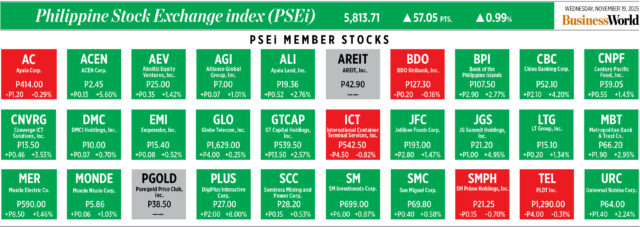
Here’s a quick glance at how PSEi stocks fared on Wednesday, November 19, 2025.


Here’s a quick glance at how PSEi stocks fared on Wednesday, November 19, 2025.
By Alexandria Grace C. Magno
PHILIPPINE STOCKS rose on Wednesday, bolstered by bargain-hunting and optimism that the Bangko Sentral ng Pilipinas (BSP) could cut policy rates in December, a move investors hope will support growth amid slowing domestic demand.
The Philippine Stock Exchange index (PSEi) added 0.99% or 57.05 points to close at 5,813.71, while the broader all-share index gained 0.62% or 20.29 points to 3,251.84.
“The local bourse ended higher, still driven by bargain-hunting,” Luis A. Limlingan, head of sales at Regina Capital Development Corp., said in a Viber message. “Moreover, investor sentiment improved after the BSP signaled the possibility of another rate cut by the end of the year. This expectation continued to support buying activity in today’s session.”
BSP Governor Eli M. Remolona, Jr. on Tuesday said a reduction at the Monetary Board’s Dec. 11 meeting is possible, likely in a modest 25-basis-point (bp) step.
The central bank has lowered borrowing costs by 175 bps since August 2024, bringing the benchmark rate to 4.75%, its lowest in over three years.
Cuts have been prompted by slowing economic growth, subdued inflation and weaker investor confidence following the flood control corruption scandal that dented business sentiment and domestic consumption.
“The market continued its slow climb, now at its short-term resistance as investors supported local equities, while waiting for Nvidia Corp. earnings, which could offer a glimpse of US equities’ future,” AP Securities, Inc. said in a market note.
US stocks fell, with major indexes dipping below a key technical level for the first time since April, amid caution ahead of retail and semiconductor earnings and a delayed job report.
Back home, most domestic sectoral indexes advanced. Financials rose 1.77% to 1,932.09; industrials jumped 1.55% to 8,517.88; holding firms gained 1.13% to 4,534.39; property added 0.43% to 2,118.71; and services edged up 0.07% to 2,362.88. Mining and oil fell 0.47% to 12,765.5.
Market breadth was positive with 112 advancers versus 61 decliners, while 67 stocks were unchanged.
Value turnover dipped slightly to P6.23 billion on 886.24 million shares, down from P6.67 billion on 1.15 billion shares on Tuesday. Net foreign selling eased to P915.4 million from P1.31 billion.
The PSEi’s modest rebound reflects growing investor optimism that further monetary easing could lower borrowing costs, support domestic consumption and stabilize business sentiment, even as uncertainties linger over global markets and domestic corruption issues continue to weigh on confidence.

By Justine Irish D. Tabile, Reporter
THE Philippine Retailers Association (PRA) said it remains optimistic about its members’ sales prospects during the year-end holidays, even in the face of fears spending will be dampened by the corruption crisis.
PRA Chairman Roberto S. Claudio told BusinessWorld that retailers continue to expect sales growth of 10-15% over the full year.
“As the country navigates ongoing economic challenges, the PRA remains optimistic about the upcoming Christmas season — traditionally the busiest and most vibrant period for Philippine retail,” the group said in a statement.
“Despite headwinds, the resiliency and resourcefulness of Filipino consumers continue to anchor industry confidence,” it added.
It said the industry is counting on overseas Filipino worker remittances, which could have an outsized impact this year because of the peso’s weakness.
“We anticipate the influx of remittances, which historically boosts spending on value-for-money gifts, household needs, and personal purchases during the holidays,” PRA said.
“We encourage retailers nationwide to gear up with their strongest value offerings and prepare their teams, stores, and online channels for increased activity,” it added.
John Paolo R. Rivera, a senior research fellow at the Philippine Institute for Development Studies, said that he expects retailers “to see a moderate but positive Christmas season driven by strong remittances, holiday traditions, mall traffic, and demand for affordable gifts.”
“However, growth will be more cautious than robust as households deal with income losses from recent typhoons, high food prices, weaker confidence, and tighter credit conditions,” he said via Viber.
“Retailers offering discounts, value packs, and flexible payment options will benefit most, as consumers prioritize essentials while still finding room to celebrate,” he added.
Toby Allan C. Arce, head of sales trading at Globalinks Securities and Stocks, Inc., said his retail outlook for the end of the year is cautiously optimistic.
“Sales should receive a solid lift from traditional drivers like festive promotions, mall events, year-end bonuses and payouts, increased remittances from overseas Filipino workers, and heavy marketing pushback by brands that want to recoup lost ground after a weaker year,” he said via Viber.
“E-commerce and omnichannel tactics will likely capture a growing share of incremental demand, while experiential draws — pop-up stores, holiday activations, and partnership tie-ins — can drive foot traffic back into malls,” he added.
However, he said elevated inflation, declining consumer confidence, and logistical snags could dampen demand.
“Other risk factors include sharper income inequality that shifts spending toward value and discount channels, any abrupt policy or tax changes that affect retail margins, adverse weather events that limit mall access, and competitive discounting that erodes profitability even if volumes rise,” he added.

THE VISAYAS was placed under yellow alert for five hours on Tuesday following outages at a number of power plants, according to the National Grid Corp. of the Philippines (NGCP).
In an advisory, the NGCP said it raised the yellow alert over the Visayas grid between 3 p.m. and 8 p.m.
Peak demand hit 2,351 megawatts (MW) while available capacity was 2,694 MW.
A total of 898.6 MW was unavailable to the grid as 16 power plants went on forced outage while 14 were running on derated capacity.
Contributing to the declaration of yellow alert was the unavailability of the 340-MW Toledo coal-fired power plant in Cebu.
The alert was also partly triggered by the emergency shutdown of Leyte Geothermal Power Plant Unit 3, bringing down the capacity of the facility from 79.5 MW to 39.3 MW.
The Luzon and Mindanao grids are normal, the NGCP said.
A yellow alert is issued when the operating margin is insufficient to meet the transmission grid’s contingency requirement. — Sheldeen Joy Talavera

PHILIPPINE JOBSEEKERS are among the most vulnerable to fraudulent job offers in the Asia-Pacific, according to online employment company Jobstreet by SEEK.
SEEK’s fraud detection systems ranked jobseekers in the Philippines as the second-largest target of false job offers in the region, accounting for 20% of job fraud attempts in the Asia-Pacific.
Indonesia accounted for 38% of all job fraud attempts in the region, it said.
Around 1.96 million Filipinos were jobless in September, equivalent to a 3.8% unemployment rate, according to the Philippine Statistics Authority.
SEEK noted that scammers targeted job offers in the Philippines for jobs in accounting, sales, healthcare and medical, administration and office support, manufacturing, transportation, and logistics.
Across the region, false job ads were most common in administration and support roles, accounting for 22% of fraudulent offers, as these typically do not require specialized degrees or experience, according to Tom Rhind, head of trust & safety at SEEK.
“Combined, these entry-level categories create larger pools of potential victims and make it easier for scammers to cast wide nets with convincing-looking opportunities,” Mr. Rhind said.
Scammers have also been using artificial intelligence to create sophisticated job offers, it said.
Some also contact job candidates via messaging and social media platforms impersonating Jobstreet and SEEK personnel.
Jobstreet by SEEK said its measures against fraud focus on automated blocking, improved verification, and collaboration with government and industry partners.
The company added that it has been educating jobseekers on scams, unfair hiring practices, and online protection through its Security & Privacy Hub.
Job candidates in the region flagged 22,000 suspicious ads on Jobstreet by SEEK platforms, which have been reviewed by its Trust & Safety team.
“We encourage all hirers and job seekers to use legitimate job platforms to ensure that every connection leads to real opportunities,” Jobstreet by SEEK Managing Director in the Philippines Dannah Majaracon said.
Jobstreet by SEEK compiled its data from SEEK’s internal fraud-detection systems between July 2024 and June 2025 across its regional platforms, including Jobstreet and Jobsdb. — Beatriz Marie D. Cruz
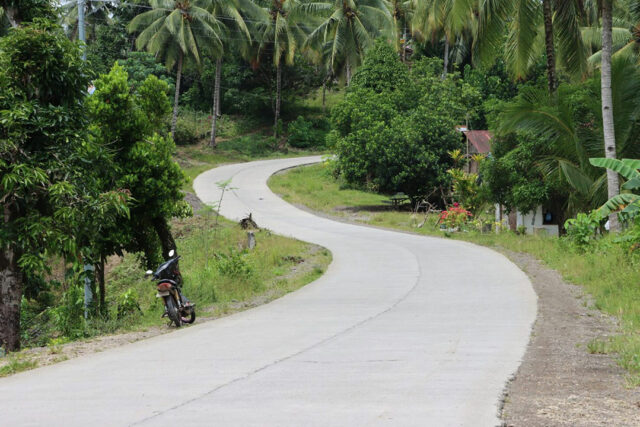
THE Department of Agriculture (DA) is proposing to implement new cost benchmarks in budgeting for farm-to-market (FMR) roads, a Senator said during the DA’s budget deliberations.
“There’s going to be a recomputation of the cost,” Senator Francis Pancratius N. Pangilinan, said late Tuesday.
Mr. Pangilinan, who sponsored the DA’s budget in plenary, added that “there will be a menu and a range of costs per kilometer depending on terrain… elevation, location, and slope.”
Last month, the DA announced that it will take over the farm-to-market road program from the Department of Public Works and Highways, which is grappling with a broader corruption scandal in its infrastructure projects.
Transferring supervision of the FMR program to the DA expects to cut costs by at least 20% and accelerate construction. The DA hopes to construct about 131,000 kilometers of FMRs, with about 70,000 kilometers already built.
“Because of the flood control scandal, it was suggested and adopted by the DA, that the Farm-to-Market Road program will now be executed or implemented by the DA under the Bureau of Agriculture Fisheries Engineering (BAFE),” he added.
“Then this will be monitored more effectively,” he said.
The Senate Finance Committee has estimated that the government lost more than P10 billion due to the overpricing of FMRs in 2023 and 2024.
“The major considerations since coming up with the list of projects would be production area, number of farmers who will benefit, vulnerability of project site, current road condition, and connectivity linkages to the markets,” Mr. Pangilinan added.
The DA was allocated about P159.23 billion in the Senate’s version of the 2026 budget bill, against the P180.28 billion proposed in the House bill.

By Kenneth Christiane L. Basilio, Reporter
PHILIPPINE IMPORTS are outperforming exports after it signed a number of free trade agreements (FTAs), the Department of Economy, Planning, and Development (DEPDev) told the House of Representatives.
Richard Emerson D. Ballester, an assistant director with DEPDev’s Trade, Services and Industry office, said the Philippines is struggling to maximize its trade agreements as reflected in the low utilization rates for exports eligible for concessional trade terms.
As such, imports are likely benefitting more from improved market access than Philippine exports, he said.
“We want to increase our market access but the utilization is still low,” he said at a House of Representatives hearing.
In 2024, only 5% of Philippine exports benefited from the trade deal with Japan, compared to the 12.2% of Japanese goods entering the country, according to Mr. Ballester. Exports from the Philippines to the European Free Trade Association, bloc consisting of Iceland, Liechtenstein, Norway, and Switzerland, were similarly lopsided, with only 0.0005% utilization for Philippine products compared with 32.5% for goods going the other way.
Regional trade engagements also lagged, with 53.4% of imports benefitting from the ASEAN Trade in Goods Agreement compared with just 3.15% of exports. Under the ASEAN-Korea free trade agreement, import utilization was 10.51%, while exports accounted for only 0.29%.
The utilization rate for imports under the ASEAN-India Trade in Goods Agreement was 33.7% for imports and 0.17% for Philippine exports.
Around 47.21% of imports availed of benefits under the ASEAN-Australian-New Zealand FTA, with the corresponding rate at 0.21% for exports.
Under the ASEAN-Japan Comprehensive Economic Partnership Agreement, around 0.66% of imports enjoyed preferential access compared to 0.06% of exports.
Trade utilization data with the Philippines’ other trading partners were not available, Mr. Ballester said.
Also on Wednesday, a Trade official said the Department of Trade and Industry (DTI) received clearance to sign the free trade agreement with the United Arab Emirates (UAE) after the conclusion of negotiations.
“We are just waiting from the UAE side for this to be signed and then this will go into ratification,” Marie Sherylyn D. Aquia, a DTI director for international trade relations, said at the same hearing.
The UAE is the Philippines’ 18th largest trading partner and is its top export market in the Gulf Cooperation Council. The top Philippine exports to the UAE include electrical equipment, food products, iron and steel, mineral fuels and machinery.
Both countries began talks for their Comprehensive Economic Partnership Agreement in February 2022. Once signed, it would be the Philippines’ first FTA in the Middle East.

By Vonn Andrei E. Villamiel
THE PHILIPPINES dropped 12 spots to 19th in the 2026 Climate Change Performance Index (CCPI) as weak renewable energy expansion and soft climate policies offset its strong record on greenhouse gas emissions and energy use.
The annual index, published by Germanwatch, NewClimate Institute, and Climate Action Network, ranks the climate mitigation performances of 63 countries and the European Union, which collectively account for 90% of global greenhouse gas emissions. The index looks at the progress in emissions, renewables, energy use, and climate policies.
The Philippines, which ranked 7th in the previous edition, slipped to a “medium” performance rating, overtaken by countries that advanced more rapidly in deploying clean energy and firming up climate policies. Despite the drop, the Philippines outperformed its peers in Southeast Asia with an overall score of 62.78, highest in the region.
The top three spots in the ranking remain empty as the authors noted that “no country is doing enough to prevent dangerous climate change.” Denmark again received the top ranking at fourth place, followed by the UK, Morocco, Chile and Luxembourg. Fossil fuel suppliers Saudi Arabia, Iran, the US and Russia were at the bottom of the table.
While the Philippines is often cited as a vocal advocate for climate-vulnerable nations, the CCPI gave the country a weak grade on national climate policy and a medium rating in international climate policy.
Jose Enrique A. Africa, executive director at think tank IBON Foundation, told BusinessWorld via Viber that while the Philippines is vocal about vulnerability, adaptation, and climate justice, there is “really not much real action to see.”
“The CCPI’s international-policy score presumably also assesses how the government translates international talk into domestic practice — and the Philippines isn’t really showing large-scale and consistent domestic reforms nor, actually, correspondingly credible international engagements,” Mr. Africa said.
He added that a major portion of the Philippines’ climate-mitigation budget under the Marcos administration is being poured into “corruption-ridden flood control projects.”
Climate advocacy organization Aksyon Klima Pilipinas (AKP) recently reported that the Philippines’ climate strategy is infrastructure-heavy, with the majority of its climate-mitigation budget over the past five years going to flood control and drainage projects.
“More public funds should go towards environmental protection and conservation, and genuine climate action, especially nature-based solutions. They are more cost-effective and even have co-benefits,” AKP National Coordinator John Leo Algo, who also contributed to the CCPI’s climate policy evaluation, said in a briefing last week.
According to the CCPI, only five of the 63 countries assessed earned a “high” overall rating for climate policy, while 41 countries received “low” or “very low” scores.
“Despite some visible achievements, current climate targets and their implementation are still not at a sufficient pace to keep global warming below 1.5°C. Most countries now have climate policies in place, though their effectiveness varies,” the report said.
Renewable energy also remains a major weak spot for the Philippines. According to the Department of Energy (DoE), renewables accounted for about 26% of the energy mix in 2023, with the government targeting a 35% share by 2030, based on the Philippine Energy Plan for 2023 to 2050.
While renewable energy capacity has increased in recent years, the index shows that the overall share of renewables in the Philippines is still low. The country’s 2030 targets also fall short of levels that will allow it to hit the Paris Agreement goal of limiting the rise in global temperatures to well below 2°C, preferably 1.5°C, above pre-industrial levels.
Meanwhile, the Philippines continues to perform well in terms of greenhouse gas emissions, with the index reporting relatively low per-capita levels.
The Philippines also scored well on energy use, with lower per-capita consumption than more industrialized economies. The report also found that the Philippines’ energy use trends and targets are in line with the pathways that will limit warming to well below 2°C.
Mr. Africa said the Philippines seems to do well in emissions and energy-use metrics “simply because of our economic backwardness.”
“Measured by GDP per capita, the country is still among the poorest one-third globally with correspondingly moderate per-capita emissions,“ he said.
To improve its climate change performance, Mr. Africa said the Philippines should scale up public investment in the green transition, especially in renewable energy, grid modernization, and energy storage.
“There has to be a stronger push to phase out fossil-fuel infrastructure with strengthened regulatory agencies resistant to corporate capture. Decentralized renewable generation, micro-grids, and community energy systems in remote islands to reduce vulnerability and accelerate deployment are long overdue,” Mr. Africa said.
He added that climate policy must be integrated with social development by linking climate action to labor policy, social protection, inclusive rural electrification, equitable energy access, and retraining displaced workers who depended on fossil fuel-heavy jobs.
The 30th United Nations Climate Change Conference (COP30) is entering its second week in Belém, Brazil, where countries are negotiating stronger climate action and mobilizing climate finance for vulnerable nations.
The Philippines, consistently ranked among the world’s most climate-vulnerable countries, hosts the board of the Fund for Responding to Loss and Damage, a newly established financing mechanism that provides grants to developing nations to address the impact of climate-related disasters.

THE GOVERNMENT needs to liberalize agriculture and address learning poverty to catch up with its regional neighbors, panelists told the Makati Business Club on Wednesday.
“We have to focus on agriculture and human capital. The two areas that I think we have not done much,” Ayala Corp. Managing Director Karl Kendrick T. Chua said in presentation.
Mr. Chua, a former National Economic and Development Authority director general, said the government’s priority reforms should include the human capital value chain.
He said like Vietnam, the Philippines has to fix agriculture first before moving up the value chain.
“Before I left government, we were proposing corn and livestock liberalization. So not only do we do it for rice, we do it for corn. Corn is important to keep the livestock, poultry, and the rest of the protein sector affordable,” he said.
He also proposed to liberalize the food market and deploy the Rice Tariffication Law to lower food prices and help farmers.
The Rice Tariffication Law, which took effect in 2019, allowed private traders to bring in rice shipments without restriction, though they had to pay import tariffs. Farmers groups have contended that the law unleashed the flood of rice imports that are eroding farmer livelihoods.
Mr. Chua said the Philippines needs new growth drivers and expressed doubt about whether reliance on business process outsourcing (BPO) and remittance can be sustained.
“For 25 years, we have relied on BPO and remittance to fuel growth, and because of its massive size, P4.5 trillion as of last year, it really fuels a lot of growth. But we cannot rely on that because remittance and BPO are growing at no more than 5%,” he said.
The economy is largely driven by household consumption fueled by remittances from overseas Filipino workers.
Mr. Chua noted that artificial intelligence is not the biggest threat to business process outsourcing, but rather the lack of skills and educated workers, a result of decades of neglect of the education system.
Shortcomings in healthcare also hinder many students’ educations, he said.
Mr. Chua said the demographic sweet spot is best harnessed by focusing on tourism, manufacturing, and technology.
“Because we have a demographic dividend, we should use that to fuel the next wave of growth. I propose that we focus on three kinds of tourism. Regular and leisure tourism needs a lot of catching up, but hold strong potential,” he said, adding that the Philippines needs to position itself as a health tourism destination.
Mr. Chua added that once agriculture is reformed, the goal should be to shift about 9 million workers out of farming into manufacturing, rather than services.
World Bank Philippine Lead Economist Gonzalo Varela said that alongside the human capital reforms from agriculture, health, education sectors, cited by Mr. Chua, the country, must also work to reduce learning poverty.
“You need to ensure that your population shows better indicators in terms of learning poverty,” he said.
“These are big challenges that are going to affect the ability of Filipinos to take advantage of technological change as a force for inclusive growth.”
Mr. Varela said job creation in the region and in the Philippines has been a key driver in reducing poverty, which has fallen, though vulnerabilities remain.
Many people are “one shock away, one typhoon away from falling back into poverty,” he said.
“This is a challenge that is increasingly a problem given automation and AI disruptions. There are many jobs that the youth aspires to that are at higher risk of displacement by AI, and that is a challenge,” he said. — Aubrey Rose A. Inosante

By Chloe Mari A. Hufana, Reporter
THE PHILIPPINES’ former executive secretary refuted the Presidential Palace’s claim that he voluntarily stepped down “out of delicadeza,” denying he had a hand in the alleged P52-billion insertion in this year’s spending plan.
Former Executive Secretary Lucas P. Bersamin on Wednesday said he did not file nor sign a resignation letter, contrary to what Malacañang said only two days before.
“The only letter I sent regarding my position being vacated was the one I signed late yesterday (Nov. 18) afternoon, where I said ‘I bow to the prerogative of the President’,” he told Palace reporters in a phone call in mixed English and Filipino.
“I will also not validate any claim that I resigned if there is no such resignation.”
Mr. Bersamin was accused of adding P52 billion worth of insertions in the 2025 national budget, Senator Panfilo M. Lacson, Sr. said on Tuesday, quoting former Public Works Undersecretary Roberto M. Bernardo.
According to the senator, Mr. Bernardo learned this information from now-resigned Education Undersecretary Trygve L. Olaivar, who said former Public Works Secretary Manuel M. Bonoan had asked Mr. Bersamin how they would deal with the money.
“They (Mr. Bersamin) supposedly would take charge of how to handle the P52 billion,” Mr. Lacson told the Senate plenary during the 2026 budget deliberations.
Mr. Bersamin likewise “vehemently” denied this claim in a separate Viber chat to Palace reporters late on Tuesday.
“Bernardo could not be a credible source of relevant information if his knowledge looks and sounds like at least triple hearsay,” he said.
Malacañang on Monday announced the supposed resignation of Mr. Bersamin and then-Budget Secretary Amenah F. Pangandaman, who has also been implicated in the controversy.
Mr. Bersamin recounted that a “close friend” called him up at around 12 p.m. on Monday to inform him that he will be leaving the top Cabinet post. He accepted this possibility at the time, saying he was “only serving at the pleasure of the President.”
“You ask them if they (Presidential Communications Office) had a letter,” Mr. Bersamin said. “I never did resign.”
Following their exit, former Finance chief Ralph G. Recto took over as executive secretary, while ex-economic czar Frederick D. Go moved to head the Finance department. They took their oath of office before President Ferdinand R. Marcos, Jr. on Wednesday morning in Malacañang.
Mr. Bersamin challenged his accusers, including Mr. Lacson and Mr. Bernardo, to formally charge him as he would answer accusations in a correct forum.
He said he talked with the President on Monday evening but refused to elaborate on their conversation.
DEFENSIVE, NOT INSTITUTIONAL
The removal of Mr. Bersamin from office shows the government is addressing the scandal “defensively, not institutionally,” Ederson DT. Tapia, a political science professor at the University of Makati, said in a Facebook messenger chat.
“When a top official says he did not resign but was simply told to step aside, it signals that responses are being shaped by pressure and optics, rather than by a transparent, rules-based accountability process,” he said, noting this leaves public in confusion whether the reshuffle was meant to correct or merely to contain.
Gary D. Ador Dionisio, dean of the De La Salle-College of St. Benilde’s School of Diplomacy and Governance, said the Marcos administration is under pressure both politically and publicly, which should prompt rapid responses to explosive claims from key whistleblower Mr. Bernardo.
However, Mr. Bersamin’s denial suggests the handling of the widening Marcos-related scandal has been poorly managed and unlikely to inspire public trust, he noted.
“If this administration will not act together, a social volcanic of dismay and anger might explode to their face,” he said via Facebook Messenger.
According to political science lecturer at the Ateneo de Manila University Hansley A. Juliano, Mr. Bersamin, who stood as chief justice in the Duterte administration, had long been associated with political forces considered problematic.
His positions on security issues, sometimes at odds with Mr. Marcos’ direction, suggest he likely lost the President’s confidence.
“I would wager he lost the President’s confidence, if he ever had it,” he said via Facebook Messenger.
ANGARA RESIGNATION CALLS
Meanwhile, Education Secretary Juan Edgardo “Sonny” M. Angara, who was also implicated in the scandal, said he does not see a need to step down as allegations against him are just “hearsay.”
“There are no specific accusations yet. There’s no mention of any transaction or anything,” he told reporters in Filipino. “So, if that were brought to court, it would be dismissed.”
The former senator was accused of getting kickbacks from fund insertions during his time as the chair of the Senate Committee on Finance from 2019-2024.
As finance chair, not only did he oversee the passage of the national budget annually, he also sat on the bicameral conference panel’s so-called “small committee,” where most of the alleged fund insertions reportedly took place.
His statement comes amid intensified scrutiny of officials accused of involvement in a corruption scandal tied to public works projects, allegedly funded through insertions in the national budget.
In an earlier testimony before the Senate Blue Ribbon Committee, Mr. Bernardo implicated several senators as supposed “proponents” of infrastructure projects in exchange for kickbacks.
In a supplemental affidavit, Mr. Bernardo claimed that Mr. Angara and ex-senators Mary Grace Natividad S. Poe-Llamanzares, Ramon “Bong” B. Revilla, Jr. and Ma. Lourdes Nancy S. Binay-Angeles allegedly received as much as 25% of a project’s cost as part of the so-called “commitment,” a euphemism for kickback, from items inserted into the budget bill.
Mr. Lacson on Tuesday said Mr. Bernardo had given him details alleging that Mr. Olaivar, a longtime aide of the Angara family, received kickbacks from irregular public works projects.
Mr. Olaivar allegedly took deliveries representing 12% of project costs between 2019 and 2024.
He resigned on Tuesday as education undersecretary.

THE Department of Agriculture (DA) said it has partnered with the Department of Labor and Employment (DoLE) in an emergency rehabilitation program for Bicol’s abaca industry, which employs 23,000 farmers affected by recent typhoons.
It said the farmers will be tapped to clear debris, trim damaged crops, and replant abaca.
The program will operate under DoLE’s Tulong Panghanapbuhay sa Ating Disadvantaged/Displaced Workers (TUPAD), which provides temporary employment and cash for work.
The program will help rehabilitate damaged farms. More severely damaged farms will undergo full replanting materials provided by the Philippine Fiber Industry Development Authority (PhilFIDA).
The DA said farmers will receive cash incentives ranging from P3,000 per hectare for slightly damaged farms, P5,000 for moderately damaged areas, and P10,000 for heavily affected areas. Farmers will also receive protective gear and a one-year personal accident insurance package from the Philippine Crop Insurance Corp.
PhilFIDA technicians will validate loss reports and ensure planting materials are ready before work begins. An inspection team will later monitor the survival rates of replanted abaca.
The DA said the program aims to restore over 4,500 hectares of abaca farms within three months.
Bicol is a major abaca producer with nearly one-third of the national total. The DA reported that Super Typhoon Uwan (international name: Fung-wong), which traversed Luzon in early November, damaged more than 55,000 hectares of abaca farms, destroying an estimated 7,492 metric tons of fiber valued at over P38 million. — Vonn Andrei E. Villamiel

By Kenneth Christiane L. Basilio, Reporter
THE PHILIPPINES’ anti-graft court on Wednesday assigned the first set of corruption charges against a resigned lawmaker at the center of a multibillion-peso flood control scandal that has gripped the Southeast Asian nation.
Three divisions of the Sandiganbayan will hear the cases, which include two counts of graft and one count of malversation through falsification filed by the Office of the Ombudsman on Tuesday against ex-Party-list Rep. Elizaldy S. Co and several other officials linked to misuse of public funds, according to the court’s website.
Lawyer Ruy Albert S. Rondain, Mr. Co’s counsel, did not immediately reply to a Viber message seeking comment.
The Sandiganbayan is a special court tasked with hearing graft and corruption charges. It is divided into divisions to allow for quicker disposition of cases. Mr. Co’s first graft charge will be heard by the fifth division, headed by Associate Justice Zaldy V. Trespesses.
The other graft charge, based on accusations that Mr. Co received “unwarranted” benefits from an allegedly anomalous state transaction, was assigned to the seventh division led by Associate Justice Lorifel Lacap-Pahimna.
The malversation charge against Mr. Co and others linked to alleged impropriety linked to anomalous flood control deals was raffled to the sixth division presided over by Associate Justice Sarah Jane T. Fernandez, the longest-sitting judge of the anti-graft court.
The complaints against Mr. Co and other officials stemmed from a P289.5-million dike project running along a river in the province of Oriental Mindoro south of Manila. The Independent Commission for Infrastructure (ICI) had flagged irregularities in the procurement, construction, and implementation of the flood control project.
Public Works Secretary Vivencio B. Dizon and Oriental Mindoro Governor Humerlito A. Dolor saw in September that steel sheets used in the flood mitigation project were below the mandated 12-meter specification, measuring only 3 meters, and that the material was found to be substandard.
The government of President Ferdinand R. Marcos, Jr. is grappling with a widening flood control scandal that has implicated politicians, officials and contractors in an alleged kickback scheme tied to public works projects in the disaster-prone country.
Mr. Co, who previously led the House of Representatives Appropriations Committee, had accused Mr. Marcos and former House Speaker Ferdinand Martin G. Romualdez of orchestrating the fraud. The President had received billions in kickback funds, he alleged in a series of videos released on his Facebook page last week. The Palace spokesperson denied the accusations against Mr. Marcos.
Meanwhile, the National Unity Party (NUP), the second-largest political party in the House, said that Mr. Co’s statements should be “cast into serious doubt.”
“Put simply, we believe Mr. Co is lying,” it said in a statement on Wednesday.
Mr. Co’s office did not immediately reply to a Viber message seeking comment.
“These grave allegations, if true, would constitute criminal conduct,” the NUP said. “Yet they rest entirely on Mr. Co’s statements not made under oath, uncorroborated and made while he remains outside the country and beyond the reach of lawful inquiry.”
Mr. Rondain had earlier said that Mr. Co went abroad to seek medical treatment, and the former lawmaker is reluctant to return to the Philippines over threats against his life.
The government is seeking to compel his return, with the Justice department requesting a blue notice from Interpol and planning to seek a red notice once the Sandiganbayan issues an arrest warrant for the non-bailable offense.
The political party said that ICI should exercise caution and not take Mr. Co’s allegations at face value, urging “judicious discernment in its investigation” into the multibillion-peso scandal.
“It would be a grave miscarriage of justice to pursue investigations based solely on unverified allegations,” NUP said.
NEW AFFIDAVITS
Also on Wednesday, the ICI planned its referral of cases involving several senators to the Office of the Ombudsman as it reviews new affidavits submitted by former Public Works undersecretary Roberto M. Bernardo.
“We are re-evaluating everything because of the affidavit of (former) Undersecretary Bernardo… We’re studying that,” ICI Chairman Andres B. Reyes, Jr. told reporters in a briefing.
He said the latest submission prompted the commission to review earlier case assessments, including those linked to three senators implicated in the flood control scam.
The commission initially expected to proceed with the referrals this week, but the schedule was pushed back after a planned hearing with Mr. Bernardo on Monday was cancelled due to his state-witness application.
“We’ll have a delay of maybe ten days from last Friday. Hopefully, we’ll finish it,” Mr. Reyes said.
Mr. Bernardo’s supplemental affidavit, which the ICI earlier said mirrors the one he submitted to the Senate Blue Ribbon Committee, implicated additional individuals, including former Department of Public Works and Highways (DPWH) Secretary Manuel M. Bonoan, who is currently abroad, as among those who allegedly received kickbacks from infrastructure projects.
Mr. Bernardo, in his sworn statements, also admitted facilitating alleged kickbacks for two incumbent senators, a cabinet secretary, two former senators, a former district representative, a city mayor, and another former public works undersecretary.
Meanwhile, the Department of Budget and Management (DBM) may be invited to its future hearings for a “study of the budget process,” with Mr. Reyes hinting that the commission intends to invite the agency’s new officer-in-charge.
Also on Wednesday, Batangas Rep. Leandro Antonio L. Leviste accused a fellow congressman of impropriety linked to around P22 billion of questionable infrastructure projects under this year’s DPWH budget.
He said there was “documentary evidence” supporting his allegations that the accused lawmaker “obtained and conspired” with the DPWH to rig the bidding process for the contracts to favored construction firms. — with Erika Mae P. Sinaking
