Home Blog Page 1315

GCash IPO could leapfrog Philippine startups’ growth

By Beatriz Marie D. Cruz, Reporter

THE much-awaited initial public offering (IPO) of digital wallet provider GCash could lay the groundwork for investment opportunities for Philippine startups, according to analysts.

“We need to be able to encourage founders and investors that there is an exit potential, that their investment of their time or capital in that startup can lead to an outcome that’s great for everyone,” Paulo Campos III, founding managing general partner at Kaya Founders, told BusinessWorld on the sidelines of Sinigang Valley’s BUILD Startup Festival.

The electronic wallet platform is one of the most highly anticipated IPOs this year, with the company targeting an $8-billion (P454.4 billion) valuation once it goes public.

Its parent company, Globe Fintech Innovations, Inc. (Mynt), is the first and only company to reach “double-unicorn status” after raising $300 million in a funding round in 2021, lifting its valuation to more than $2 billion.

Rene Cuartero, founder and chief executive officer (CEO) at venture capital firm AHG Lab, said the GCash IPO could be a “game-changer” for the country’s expanding startup ecosystem.

“The IPO will show proof of a pathway for a lot of our startups in the Philippines towards listing in the market,” he said on the sidelines of the event. “It will also be an excellent test case on what regulations might need to be adjusted in order to accommodate large and smaller tech companies that want to [list].”

It takes about 10 years for a startup to be ready for an IPO. If successful, this would allow startups to access a larger pool of investors and expand further, making it a more established entity in the market.

Since its launch in 2004, GCash has had more than 94 million registered users. Its popularity grew as more people adopted digital payments during the coronavirus pandemic.

Its services are available in 16 markets including the US, UK, United Arab Emirates, Australia, Canada, Germany, Hong Kong, Italy, Japan, Saudi Arabia, Kuwait, Qatar, Singapore, South Korea, Spain and Taiwan.

The GCash IPO would also increase the Philippines’ attractiveness to investors as an emerging tech hub, said Oscar Enrico A. Reyes, Jr., president and CEO at G-Xchange, Inc., the company that operates GCash.

“It’s very important that it becomes a successful IPO,” he told BusinessWorld. “And if that happens, the whole investment community starts seeing the Philippines as a potential tech hub.”

“This is something that’s homegrown, and if we can be one of the biggest and most successful kind of startup that is publicly [listed,] then hopefully it encourages more investors to look for other opportunities here in the Philippines,” he added.

Sean ‘Diddy’ Combs pleads not guilty to expanded sex trafficking indictment

Sean “Diddy” Combs — WIKIPEDIA

NEW YORK – Sean “Diddy” Combs pleaded not guilty on Monday to an expanded federal indictment charging the hip-hop mogul with five criminal counts, including racketeering and sex trafficking.

Mr. Combs, 55, entered his plea to the new charges at a hearing before US District Judge Arun Subramanian in Manhattan. He had previously pleaded not guilty to an earlier three-count indictment.

In a statement earlier this month provided by Mr. Combs’ media representatives, his lawyers said, “These are not new allegations or new accusers. These are the same individuals, former long-term girlfriends, who were involved in consensual relationships.”

Jury selection for Mr. Combs’ trial remains scheduled for May 5, with opening statements due to begin on May 12.

Marc Agnifilo, one of Mr. Combs’ lawyers, said the defense may seek a two-week delay to opening statements to allow it to review e-mails it wants an alleged victim to turn over.

Mr. Subramanian said that if the defense wants a delay, it must submit a formal request within two days.

“We are a freight train moving towards trial,” the judge said.

Prosecutors with the Manhattan US Attorney’s office say Mr. Combs used his business empire to sexually abuse women between 2004 and 2024. The alleged abuse included having women take part in recorded sexual performances called “freak offs” with male sex workers, who were sometimes transported across state lines.

Mr. Combs has been jailed in Brooklyn since September. He also faces dozens of civil lawsuits by women and men who accused him of sexual abuse.

Mr. Combs’ legal team has forcefully denied that he did anything wrong.

Mr. Agnifilo has said Mr. Combs never forced anyone to engage in sexual acts against their will, and that the freak offs were consensual sexual activity.

Also known during his career as Puff Daddy and P. Diddy, Mr. Combs founded Bad Boy Records and is credited with helping turn rappers and R&B singers such as Mary J. Blige, Faith Evans, Notorious B.I.G., and Usher into stars in the 1990s and 2000s.

But prosecutors have said his success concealed a dark side, citing incidents, including in March 2016 when Mr. Combs was captured on a surveillance video kicking, dragging, and throwing a vase at a woman trying to leave a Los Angeles hotel.

CNN last year broadcast a surveillance video showing Combs striking and dragging his former girlfriend Casandra Ventura, an R&B singer known as Cassie.

Mr. Combs apologized following the broadcast. Mr. Agnifilo has said the video was not evidence of sex trafficking, and that Mr. Combs and Ms. Ventura had “a toxic, loving 11-year relationship.” — Reuters

Transmission rates up in March

PHILIPPINE STAR/MICHAEL VARCAS

TRANSMISSION RATES for the March billing period, reflected in the April electricity bill, increased by 11.51% due to higher ancillary services (AS) charges, the National Grid Corp. of the Philippines (NGCP) said.

AS charges rose by 16.05% to P0.8094 per kilowatt-hour (kWh) in March, up from P0.6975 per kWh in February, NGCP said in a statement on Tuesday.

The company said the latest charges include the third tranche of the settlement for the remaining 70% of AS costs from the reserve market for the March billing period, the recovery of which was deferred by the Energy Regulatory Commission.

AS charges reflect the cost of power sourced from the reserve market and providers holding bilateral contracts with NGCP, who step in when supply from long-term providers is insufficient.

Meanwhile, transmission wheeling rates, or the charges for NGCP’s primary service of delivering power, slightly increased by 4.81% to P0.5505 per kWh, up from P0.5252 per kWh.

“For the April 2025 bills of end consumers, NGCP charges only 55 centavos per kWh for the delivery of its services. The bulk of transmission charges is for AS, which is remitted directly to AS providers,” the company said.

Transmission charges reflect the cost of delivering electricity from power generators to the distribution system. — Sheldeen Joy Talavera

Time’s up! Supreme Court clarifies time limit for prosecuting crimes governed by summary procedure

PHILIPPINE STAR/JOHN RYAN BALDEMOR

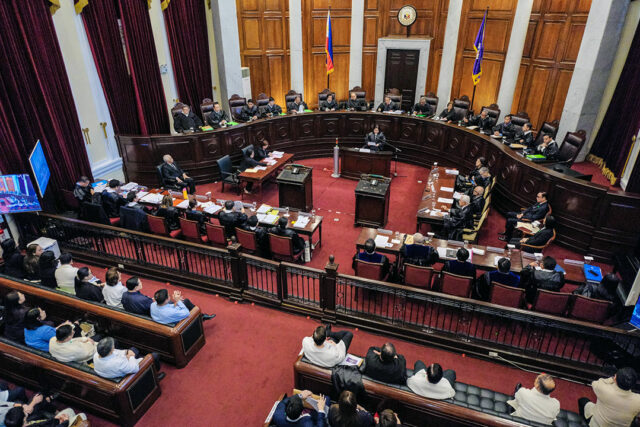
An accused can no longer be convicted of a crime, even if found guilty thereof, if the crime has already prescribed. The prescription of the crime totally extinguishes the liability of the accused. Hence, it is important to know when the prescriptive period shall commence to run and when it shall be interrupted.

In the recent case of People v. Consebido (G.R. No. 258563, April 2), the Supreme Court clarified the rule on the interruption of the prescriptive period for offenses falling within the scope of the 1991 Revised Rules on Summary Procedure, which are now governed by the 2022 Rules on Expedited Procedures in the First Level Courts.

The criminal cases governed by the Rules on Summary Procedure, as stated in the Rules on Expedited Procedures, are: 1.) violations of traffic laws, rules, and regulations; 2.) violations of the rental law; 3.) violations of municipal or city ordinances; 4.) violation of Batas Pambansa Blg. 22 or the Bouncing Checks Law; and, 5.) all other criminal cases where the penalty prescribed by law for the offense charged is imprisonment not exceeding one year, or a fine not exceeding P50,000, or both, provided that in offenses involving damage to property through criminal negligence, the Rules govern where the imposable fine does not exceed P150,000.

Under the Revised Penal Code, the prescriptive period of a crime shall be interrupted by the filing of the complaint or information. The prevailing rule is that prescription is interrupted when the preliminary investigation against the accused is commenced, such as when a complaint is filed with the prosecutor’s office.

The rationale for this rule is that aggrieved parties should not be allowed to suffer unnecessarily simply because of circumstances beyond their control, like the accused’s delaying tactics or the delay and inefficiency of the investigating agencies.

However, in the 2023 cases of Republic v. Desierto (G.R. No. 136506, Jan. 16, 2023) and Corpus, Jr. v. People (G.R. No. 255740, Aug. 16, 2023), it was held that for offenses governed by the Rules on Summary Procedure, the running of the prescriptive period shall be interrupted only upon the institution of judicial proceedings, and not the commencement of the preliminary investigation by the investigating agencies.

This ruling is anchored in Section 11 of the Rules on Summary Procedure, which provides that criminal cases falling within its scope are commenced either by complaint or information filed in court.

The Supreme Court acknowledged that, under this interpretation, a crime may prescribe even if the complaint is filed seasonably with the prosecutor’s office if, intentionally or not, the prosecutor’s office delays the institution of the necessary judicial proceedings until it is too late. However, according to the Court, this possibility should not justify a misreading of the applicable rules beyond their obvious intent as reasonably deduced from their plain language.

Thus, in Corpus, Jr. v. People, the criminal case was dismissed on the ground of prescription of the offense even if it was not due to the failure of the complainant, but that of the prosecutor’s office, to timely file the information in court.

However, in People v. Consebido, the Supreme Court En Banc abandoned its rulings in Republic v. Desierto and Corpus, Jr. v. People and clarified that the time limit or prescriptive period for prosecuting crimes, including those under the Rules on Expedited Procedures, stops running once a complaint is filed with the prosecutor’s office, and not when the case reaches the court.

It recognized that, while criminal cases should ideally be resolved promptly, delays are sometimes unavoidable. Therefore, the State, as the offended party, should not be disadvantaged by delays in the preliminary investigations, even in criminal cases under summary procedure.

The Supreme Court further clarified that the ruling in People v. Consebido on the interruption of the prescriptive period for prosecuting crimes will apply prospectively. n

The views and opinions expressed in this article are those of the author. This article is for general informational and educational purposes only and not offered as and does not constitute legal advice or legal opinion.


April Jane S. Sillada is an associate of the Litigation and Dispute Resolution department of the Angara Abello Concepcion Regala & Cruz Law Offices (ACCRALAW).

(632) 8830-8000

assillada@accralaw.com

Bold policy moves ‘in any direction’ wouldn’t be prudent, says Fed’s Bostic

ATLANTA Federal Reserve Bank President Raphael Bostic said on Monday the uncertainty surrounding the Trump administration’s tariff and other policies has put the economy into a “big pause,” and he suggested the US central bank should stay on hold until there is more clarity.

“The specific place that the economy will land depends critically on the details of where policy lands,” Mr. Bostic said, speaking at Emory University. “And because we don’t know that now, again, that’s another reason why I feel like moving too boldly with our policy in any direction wouldn’t be prudent at the moment.”

Tariffs are likely to push up on prices, Mr. Bostic said, meaning that it will take longer than he had earlier thought, perhaps until 2027, to get inflation back down to the Fed’s 2% goal. At the same time, economic growth will likely slow, with gross domestic product growing more than 1% this year, less than half the recent pace, he said.

Bostic did not say whether he still believes the Fed will cut interest rates once this year, the view he had expressed in March.

Since then, US President Donald J. Trump has announced tariffs on dozens of countries, and then proceeded to roll back some of the new tariffs temporarily even as he ratcheted up import levies on China, which has retaliated with big tariffs of its own.

The result, analysts say, is that tariffs on US imports now average out at about 25%, about tenfold what they were when Mr. Trump took office in January.

It is unclear if tariffs will remain there. Trump on Monday, in his latest shift, floated possible exemptions to his auto tariffs, even as the administration opened investigations into pharmaceutical and chip imports, a move that could presage fresh tariffs.

“I think the fog has just gotten really, really thick,” Mr. Bostic said. “The economy is in a big pause position and we’ll just have to see sort of how things evolve.” — Reuters

Overseas Filipinos’ Cash Remittances

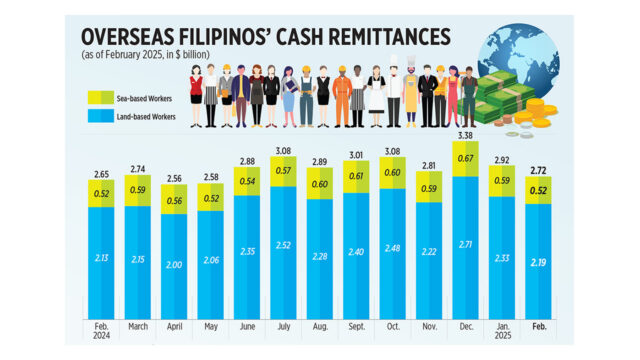
MONEY SENT HOME by migrant Filipinos rose by 2.7% year on year in February, the slowest in nine months, data from the Bangko Sentral ng Pilipinas (BSP) showed. Read the full story.

Overseas Filipinos’ Cash Remittances

1Life uses artificial intelligence to fast-track medical diagnosis

FACEBOOK.COM/1LIFE.PH

By Almira Louise S. Martinez, Reporter

1LIFE, INC., a tech company that conducts medical missions nationwide, seeks to reduce the long process of medical diagnosis in the Philippines through its artificial intelligence (AI) platform, DocMate AI.

1Life, Inc. President Niño L. Namoco said the shortage in healthcare professionals in the Philippines causes doctors to be swamped with patients, leading some of them to overlook their patients’ other diseases.

A report from the University of the Philippines showed there are 3.7 doctors per 10,000 Filipinos, far from the 10 doctors recommended by the World Health Organization.

“That’s why we made this innovation, the DocMate AI, which helps doctors make accurate diagnoses and become more efficient,” Mr. Namoco told reporters at the platform launch on Friday.

The medical history, symptoms and test results gathered for each patient are uploaded on the AI platform so it could recommend all possible diagnoses. With the help of the AI platform, a doctor can diagnose 50 to 100 patients a day.

“AI can only suggest based on all data,” Barangay Health and Wellness Party-list Rep. Minguita Padilla said. “The beauty of data is it won’t miss anything,” the doctor said at the same briefing in Filipino.

Although it is time-efficient, some doctors still hesitate to trust the AI platform.

“At first, some doctors feel that this will become a replacement, but again, this is just a tool,” Mr. Namoco said. “The challenge is for the doctor to accept that this is a tool that you can use to help you to be more accurate, to be more efficient with your diagnosis.”

The lengthy consultation process also motivated 1Life to create the AI-powered doctor’s assistant. Mr. Namoco said the typical consultation process lasts at least four days in the Philippines.

He noted that patients usually line up the whole day to see a doctor. After the initial check-up, the physician would ask for medical laboratory tests which could take a day or two.

After getting the laboratory results, patients spend another day lining up at the clinic or hospital to present laboratory results and get diagnosed.

“Whether you’re from a far-flung barangay or are in Metro Manila, you face that four-day problem,” Mr. Namoco said.

1Life and DocMate AI minimize the process to one hour and thirty minutes because procedures like complete blood count (CBC), ultrasound, X-ray, urinalysis and electrocardiogram (ECG) can be done at the medical mission.

1Life holds eight to 15 medical missions daily, with four to six attending doctors at each mission. In 2024, the company had 500,000 patients in more than 70 provinces nationwide. It aims to help one million patients by year-end.

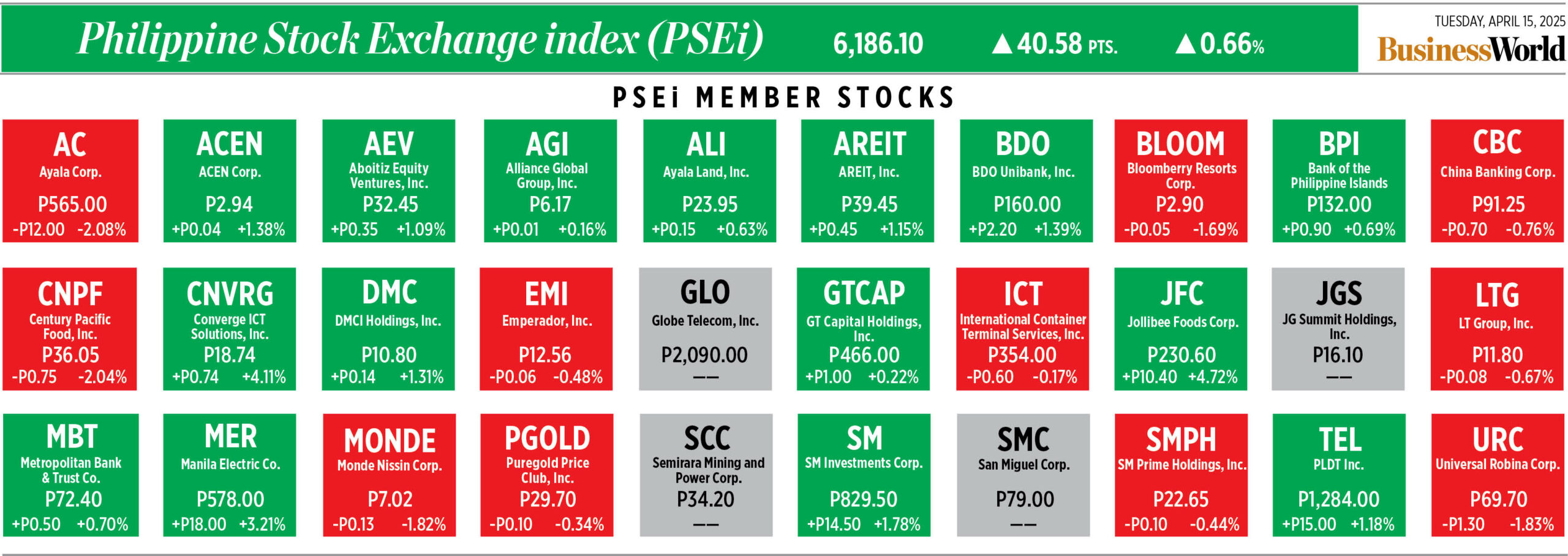
How PSEi member stocks performed — April 15, 2025

Here’s a quick glance at how PSEi stocks fared on Tuesday, April 15, 2025.


Peso surges to over 6-month high vs dollar

BW FILE PHOTO

THE PESO surged to an over six-month high on Tuesday as fears of a global recession due to the Trump administration’s shifting trade policies continue to weigh on the US dollar.

The local unit closed at P56.77 per dollar on Tuesday, jumping by 31 centavos from its P57.08 finish on Monday, Bankers Association of the Philippines data showed.

This was the peso’s strongest finish in over six months or since it closed at P56.295 on Oct. 4, 2024.

The peso opened Tuesday’s session stronger at P57.03 against the dollar. It dropped to as low as P57.15 during the session, while its intraday best was its closing level of P56.77 versus the greenback.

Dollars traded surged to $2.13 billion on Monday from $1.48 billion on Tuesday.

“The dollar-peso closed higher, still on concerns over US President Donald J. Trump’s tariff policy, which continued to put pressure on investor sentiment against the greenback,” a trader said in a phone interview.

The peso was also supported by the increase in remittances ahead of the Holy Week break, Rizal Commercial Banking Corp. Chief Economist Michael L. Ricafort said in a Viber message.

For Wednesday, the trader expects the peso to move between P56.70 and P57.10 per dollar, while Mr. Ricafort said it could range from P56.70 to P56.90.

Philippine financial markets will be closed on April 17 (Thursday) and 18 (Friday) for non-working days in observance of Holy Week.

The dollar held steady on Tuesday, trading near a three-year low against the euro and a six-month trough against the yen, as investors trying to make sense of the constant changes to Mr. Trump’s tariffs remained wary of US assets, Reuters reported.

Much of the volatility that hit the dollar last week and sent Treasury yields soaring appeared to have abated somewhat on Tuesday, although investor sentiment was still fragile.

The euro, which has been one of the biggest beneficiaries of this month’s dumping of US assets, was a touch weaker on the day at $1.1336, narrowly below last week’s three-year high at $1.1474.

The dollar was slightly weaker at 142.99 yen, staying close to the six-month low of 142.05 it touched on Friday.

Market focus has been on the ever-shifting tariff headlines with the US removing smartphones and other electronics from its duties on China over the weekend providing some relief, although comments from Mr. Trump suggested the reprieve is likely to be short-term.

Mr. Trump’s imposition and then abrupt postponement of most tariffs on goods imported to the US has sown confusion, adding to the uncertainty for investors and policymakers around the world.

There was a greater sense of calm across the market on Tuesday. But given the uncertainty Mr. Trump and his vacillation over tariffs have stirred up, analysts expected the reprieve for the dollar to be short-lived.

The dollar index, which measures the US currency against six others, was at 99.641, not far from last week’s three-year low. The index is down over 4% this month, set for its biggest monthly drop since November 2022.

The more risk-linked currencies enjoyed a bout of strength. Sterling was up 0.1% at $1.347, while the Australian dollar rose 0.7% to $0.6371and the New Zealand dollar gained 0.71% to reach $0.592, near its highest in four and half months. — A.M.C. Sy with Reuters

PSEi rises to near two-week high on tariff relief

PHILIPPINE STAR/KRIZ JOHN ROSALES

PHILIPPINE STOCKS closed higher on Tuesday to track Wall Street’s rise overnight amid some relief from the volatility caused by the Trump administration’s changing tariff policies.

The benchmark Philippine Stock Exchange index (PSEi) rose by 0.66% or 40.58 points to end at 6,186.10, while the broader all shares index went up by 0.51% or 18.76 points to close at 3,646.65.

This was the PSEi’s best close in nearly two weeks or since it ended at 6,247.68 on April 2.

“The local market rose further this Tuesday as investors took cues from Wall Street’s climb overnight,” Philstocks Financial, Inc. Senior Research Analyst Japhet Louis O. Tantiangco said in a Viber message. “Investors are pinning hopes on the possibility of a US-Philippines trade deal that could lead to lower tariffs of the former against the latter.”

“Investors are also hopeful that the BSP (Bangko Sentral ng Pilipinas) would cut rates further moving forward to give the local economy a boost.”

The three major US stock indexes ended higher on Monday, with Apple giving the S&P 500 a strong boost as the White House exempted smartphones and computers from new tariffs, Reuters reported.

Uncertainty over future tariffs kept investors cautious, however, as investors remain worried about how companies will manage supply chains as more developments are expected on the tariff front.

Meanwhile, Malacañang said on Monday that Special Assistant to the President for Investment and Economic Affairs Frederick D. Go will lead a delegation that will head to the US in May to negotiate the 17% “reciprocal” tariff to be imposed on the Philippines’ exports to the US.

“Philippine shares pushed closer the 6,200 level as sentiment continued to improve with the markets calming down before the Easter holiday,” Regina Capital Development Corp. Head of Sales Luis A. Limlingan said in a Viber message.

Philippine financial markets will be closed on April 17 (Thursday) and 18 (Friday) for non-working days in observance of Holy Week.

Almost all sectoral indices closed higher on Tuesday. Industrials climbed by 1.29% or 112.04 points to 8,744.34; financials went up by 0.77% or 18.29 points to 2,394.29; holding firms increased by 0.61% or 31.49 points to 5,139.55; services rose by 0.38% or 7.61 points to 1,964.65; and property inched up by 0.27% or 6.13 points to end the session at 2,218.99.

Meanwhile, mining and oil slipped by 0.03% or 3.40 points to 9,571.98.         

Value turnover rose to P4.46 billion on Tuesday with 1.4 billion shares traded from the P4.32 billion with 557.88 million issues that changed hands on Monday.

Advancers beat decliners, 102 against 79, while 66 names were unchanged.

Net foreign buying went up to P205.99 million on Tuesday from P174.58 million on Monday. — Revin Mikhael D. Ochave with Reuters

Ceiling prices set for 4th green energy auction

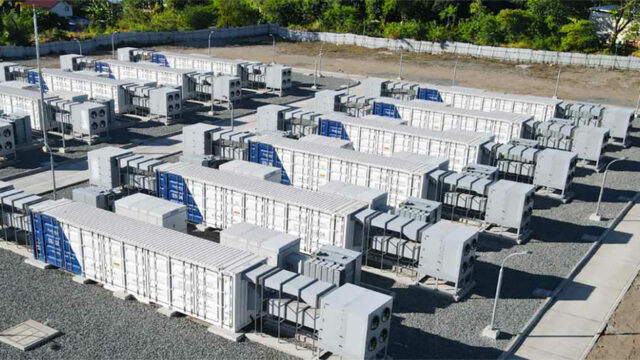
BATTERY Energy Storage System of the Masinloc Power Plant — SMCGLOBALPOWER.COM.PH

THE Energy Regulatory Commission (ERC) has issued its proposed ceiling prices for the fourth round of the green energy auction (GEA-4) which will be held this year, with the auction focused on integrated renewable energy and energy storage systems (IRESS).

In a notice, the ERC proposed a preliminary price of P4.1480 per kilowatt-hour (kWh) for ground-mounted solar, P5.9515 per kWh for floating solar, and P4.7679 per kWh for rooftop solar.

For other technologies, the ERC is looking to set a ceiling of P6.5134 per kWh for onshore wind and P5.2835 per kWh for solar systems equipped with energy storage.

GEA-4 will offer 10,478 megawatts (MW) of RE capacity, which include some that will be paired with battery energy storage systems, the Department of Energy (DoE) said last month.

This covers 3,940 MW of ground-mounted solar, 3,000 MW of floating solar, 48 MW of roof-mounted solar, and 2,390 MW of onshore wind.

The ERC determines the green energy auction reserve (GEAR) price, or the maximum price in pesos per kilowatt-hour that will serve as the ceiling price for the auction.

The ERC is scheduled to conduct public consultations on the proposed preliminary GEAR prices for GEA-4 next week.

The GEA program aims to promote RE as a primary source of energy through competitive selection. RE developers compete for incentivized fixed power rates by offering their lowest price for a certain capacity.

As a flagship government initiative, the program is expected to contribute to the government’s goal of 35% RE in the power generation mix by 2030.

Winning RE projects will be awarded a 20-year supply contract starting from the commercial operation date of the plant.

“By providing energy developers with opportunities to secure long-term contracts, GEA fosters sustainable energy production while ensuring a more stable, reliable, and greener power supply for the nation,” the DoE said. — Sheldeen Joy Talavera

NFA to auction rice to free up warehouse space

REUTERS

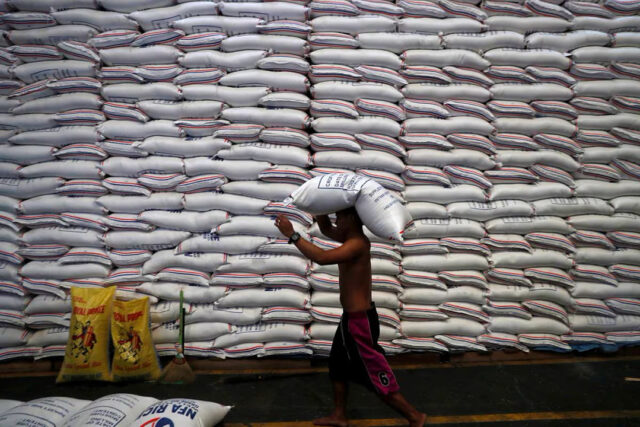
THE National Food Authority (NFA) said it will auction its older rice stocks by early May to facilitate more rice procurement, following weak take-up from local government units (LGUs) during the food security emergency.

NFA Administrator Larry del Rosario Lacson said the auction is authorized by the Department of Agriculture’s (DA) emergency order, which allows for the disposal of NFA inventory to boost supply and stabilize prices.

“I will launch an auction under the law,” he told reporters. “We will be targeting the regions whose warehouses are full so that we can free them up, then we can buy.”

Mr. Lacson said the NFA has yet to determine the floor price for the auction but noted that it is weighing a price that will be attractive relative to the P30-P34 per kilogram price traders pay for imported rice.

“You can set it at P38 but if they can buy imported rice at P30 to P34, who will bid?”

Mr. Lacson said farmer cooperatives and the private sector will also be allowed to participate in the auction.

The DA on Feb. 3 declared a rice emergency, allowing the NFA — which is barred by law from selling rice directly to the public — to release inventory to government agencies, LGUs, and government-backed markets.

However, the NFA said the volume of rice it had released since the emergency declaration was only 20,000 bags — well below the monthly target of 500,000 bags.

The NFA’s rice inventory as of April 11 was equivalent to 7.17 million bags, including 9 million bags of palay (unmilled rice) and 1.2 million bags of rice.

Rice imports fell 46% year on year to 641,000 metric tons in the year to date ending March 13. A US Department of Agriculture report in March said Philippine rice imports will likely decline 1.9% to this year due to an expected increase in domestic production.

The farmgate price of palay continues to decline by a reported 24.4% year on year in March to an average of P18.57 per kilogram.

The NFA, which is required by law to buy palay from farmers to maintain a minimum rice inventory, pays P23 to P30 per kilo for clean and dry palay, and P17 to P23 per kilo for fresh/wet palay.

Raul Q. Montemayor, national manager of the Federation of Free Farmers, said the average farmgate price of P18.57 per kilo for dry palay would be equivalent to around P15-16/kilo for wet/freshly harvested palay.

But some farmers were citing farmgate prices of P13-14 per kilo for freshly harvested palay, he said via Viber.

“Imports in January-February appear to have slackened but picked up in March.  There was also probably a lot of leftover stock from last year that spilled over to 2025 which, together with incoming harvests, led to higher total supply,” he noted.

Mr. Montemayor said international prices continue to fall, “so palay traders are probably hedging against low market prices in the coming months and therefore buying from farmers at a low price.” — Kyle Aristophere T. Atienza