Home Blog Page 1295

Waller says stablecoins will bring benefits to US payments system

US FEDERAL RESERVE Governor Christopher Waller said on Friday that stablecoins are a good thing for the US payments system, but he doubts the financial system can support a large number of these assets.

“I’ll say I’m a personal, big advocate of stablecoins,” Mr. Waller said at a New York Fed event. “I have been saying this for over three-plus years now, about how this could bring competition, efficiency and speed into the payments system.”

“Do I think there’s going to be 100 stablecoins circulating after legislation happens? I don’t think so,” he added.

Mr. Waller is leading the work on payments system issues for the US central bank, a job he acknowledges would have at one point been grim but is now “fascinating” given the level of innovation happening in the sector. He noted “if you had told the (Fed) governor 25 years ago they had to oversee the payments committee, they’d put a gun in their mouth.”

Mr. Waller again noted that he sees no need for the Fed to adopt its own fully digital dollar and said that it’s best when the private sector leads payments system innovation.

“I prefer to let the private sector solve these problems,” Mr. Waller said. “It’s not my job as an unelected bureaucrat to tell everybody how they should do things,” he said, adding that the Fed’s role is to “convene the industry together to think about what the problems are” and how they can be solved.

Mr. Waller also reiterated that the challenge of speeding up the payments system is that everyone wants to get paid quickly but not everyone wants to send the cash as quickly. — Reuters

Chinese have integrated into Southeast Asia for centuries. Could that fray?

CHINATOWN, Yaowarat Road, Samphanthawong, Bangkok, Thailand — TOM LORBER-UNSPLASH

A FEW WEEKS AGO, I posted a preview of Strangers in the Land: Exclusion, Belonging, and the Epic Story of the Chinese in America, Michael Luo’s moving, eloquent and meticulously researched history of immigration. In a way, Luo’s book, which officially publishes on April 29, is a companion to Edward Wong’s poignant At the Edge of Empire: A Family’s Reckoning with China, which I’ve also featured in a column.

While Luo’s book examines nearly 200 years of Chinese immigration into the US — with a mesmerizing focus on the turbulent, often genocidal late 19th century in California and the Pacific states — Wong follows his father’s epic journey from coastal China and Hong Kong in World War II up to Manchuria during the Korean War and then westward to the home of the Uyghurs in Xinjiang, which was being welded into the People’s Republic, and where Han majority of the rest of the country was a privileged minority. Together, the books provide a stereoscopic view of Chinese identity — the experience of migrants to a distant continent of promise and hostility, and of Chinese in China itself as the nation settled into its territorial bounds and ambitions.

I believe there’s a third aspect awaiting magisterial treatment: the saga of the Chinese in Southeast Asia. Today, the region stretching from Myanmar to New Guinea is the home to more than 675 million people in about a dozen countries, including the vibrant economies of Indonesia, Vietnam, the Philippines, Malaysia, and Thailand. Among them are about 25 million people of Chinese ethnicity. According to some studies by the family office industry, about three-quarters of Southeast Asia’s roughly $400 billion in personal wealth is held by the region’s Chinese. In addition, Southeast Asia also has a substantial number of people with some Chinese ancestry, a statistic that is difficult to assess, making this region particularly intriguing. It’s because the Chinese in Southeast Asia, while affluent and influential, can seem to disappear in plain sight — a skill they’ve honed at great cost over the last three or four centuries. It is the paradoxical key to their persistence in the sometimes inhospitable nations where they live.

For example, while ethnic Chinese form perhaps 14% of Thailand’s population of 66 million, one study estimates that as much as 40% of all Thai have some Chinese DNA. That includes the royal family and many of the families who dominate politics and the military. There’s a parallel situation in the Philippines: While the official number of Chinese is perhaps 1 million out of the total of 110 million, the traditional ruling class has many Chinese ancestors in their family trees. Intermarriage and integration were part of the Chinese immigrant survival process. That’s created the distinct cultures in the region, including the Peranakan in the Malay Peninsula as well as local vocabularies replete with words that can trace their origin from China’s coastal regions in Guangdong and Fujian, the source of most of the migrants to Southeast Asia. There is a continuity between the delights of Bangkok street food and the cooking of China’s Teochew people.

While assimilation helped integrate the migrants, their presence — both genetic and cultural — chronically triggers nativist hostility. Singapore was expelled from the Malaysian Federation in 1965 because the city was predominantly Chinese. In the 1960s, too, anti-communist mobs targeted Chinese Indonesians simply because of the China connection. Most of the victims weren’t members of the party, but because China was ruled by communists, they were victims of violence and massacre. Many of the so-called boat people escaping Vietnam after the fall of Saigon in 1975 were ethnic Chinese, fleeing a regime inimical to their race and culture despite their lifetimes in the country.

Xenophobia is a universal human disease. But this was more than a fear of strangers: It was uneasiness from living in the shadow of the giant, often grabby empire to the north that the migrants left long ago. The Spanish and Dutch colonial governments in the Philippines and Indonesia slaughtered or ousted ethnic Chinese. In the 17th century, the Spaniards were constantly afraid that China (or Chinese pirates operating out of Taiwan and the islands in the South China Sea) would invade Manila. The Dutch went out of their way to label Chinese residents as foreigners and discriminated against them as carpetbaggers and opportunistic merchants, slurs adopted by locals. Vietnam — ruled at various moments by Chinese dynasties — had fought wars of independence as well as fended off invasions (one as recent as 1979). There’s a lot of history and paranoia.

And so Chinese migrants — often fleeing poverty and turmoil in China — had to deal with the perception of being agents of a predatory foreign power. But not — in the 1950s to ’70s — as a military threat. Most countries perceived China as a source of ideological subversion rather than a potential invader (apart from Vietnam, which in any case was able to fight Beijing to a draw in that desultory one-month war). That was because the People’s Republic was in the middle of its many convulsions — the catastrophic Great Leap Forward, the cancerous Cultural Revolution, the nebulousness of the post-Mao era. It was a basket case of self-defeating ideology and cliquish mayhem. Why would any person of Chinese descent in relatively prosperous Southeast Asia want to be associated with all of that? It was impetus for further integration into their local societies. I remember that sentiment growing up ethnic Chinese in the Philippines in the 1960s: China was for losers.

But that’s all changed — so is the calculus for the visibility of Chinese-ness in the region. China is the second-biggest economy in the world; its tourists spend millions; its companies invest billions; and for more than a decade now, it has become the largest trading partner of the Association of Southeast Asian Nations, the 10-country economic and political bloc encompassing most of the area. All that may be a prod to greater cooperation with China, if only to hang together against US President Donald Trump’s tariffs (Cambodia, Laos, and Vietnam got the highest at 49%, 48%, and 36%, respectively; Singapore got the minimum 10%). And in Southeast Asia, people of Chinese ancestry are suddenly proud — or at least curious in a positive way — about their heritage. Think of the movie Crazy Rich Asians with the Chinese quotient turned way up. At the same time, China has enough military muscle that it can’t be cast as the regional loser anymore. Indeed, the Philippines is once again being threatened by Chinese navies.

And so, as the region’s people of Chinese descent undergo stirring of suppressed identity because of a resurgent China, the nations of Southeast Asia are increasingly wary of their giant neighbor with its ships and soldiers, investors and money. Will we see partnerships, rivalries, and fair weather friendships? Will China play on ancestral heartstrings? It’s a conjunction of sentiments that’s not quite happened before. Someone better get cracking on a book.

BLOOMBERG OPINION

Inflation rates in the Philippines

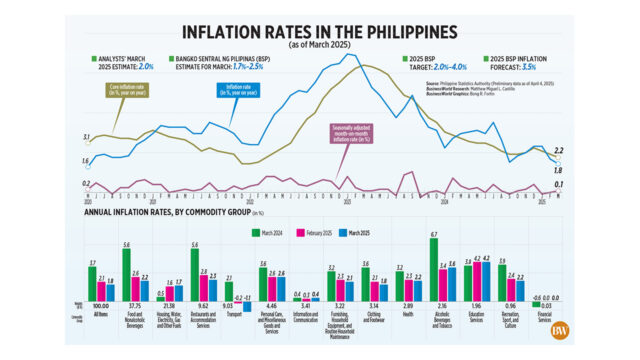
Inflation eased to its lowest annual rate in nearly five years in March, as food and transport costs rose at a slower pace. Read the full story.

Inflation rates in the Philippines

US FDA suspends program to improve bird flu testing as federal gov’t cuts staff

REUTERS

THE US Food and Drug Administration (FDA) is suspending efforts to improve its bird flu testing of milk, cheese and pet food due to massive staff cuts at the agency, according to an e-mail seen by Reuters and a source familiar with the situation.

The FDA’s testing for bird flu in dairy products has found that pasteurization kills the virus, and has also provided clues to the scope of the virus’s spread. At least two house cats have died after eating raw pet food that later tested positive for bird flu.

The Department of Health and Human Services (HHS), which includes the FDA, began firing 10,000 employees to comply with President Donald Trump’s push to shrink the federal workforce, an effort overseen by billionaire ally Elon Musk.

The Interlaboratory Comparison Exercise for detecting Highly Pathogenic Avian Influenza was set to launch later this month but was suspended on Thursday because of cuts to staff at the FDA’s Human Food Program that would have supported the scientific and testing needs of the program, the e-mail said.

The program would have included more than 40 laboratories across FDA’s Veterinary Laboratory Investigation and Response Network (Vet-LIRN) and USDA’s National Animal Health Laboratory Network, as well as FDA food labs and private industry, said the e-mail, which was sent to network laboratories from the Vet-LIRN program office.

“(The program) would have been critical to ensure confidence in the laboratory methods for food safety and animal health,” the e-mail said.

HHS did not immediately respond to questions about the suspension of the program and what, if any, impact it would have on FDA’s bird flu testing efforts.

The FDA handles testing of consumer dairy products for bird flu, while the US Department of Agriculture tests bulk milk before it is sent for processing. An ongoing bird flu outbreak in dairy cattle has infected nearly 1,000 herds, according to USDA data.

The coordination effort would have served as a quality assurance program to ensure reliable results in the FDA’s bird flu testing of dairy products and pet food, according to a source familiar with the situation.

Similar coordination programs at the FDA ensure reliability in testing for salmonella and other pathogens, the source said. — Reuters

MIAS @ 20 rolls off on April 10

Manila International Auto Show (MIAS) organizers and auto executives at the opening of last year’s edition of the exhibition — PHOTO BY KAP MACEDA AGUILA

THE MANILA International Auto Show (MIAS), the country’s premier auto show, is poised to hold its 20th edition this Thursday — seeking to highlight “the newest technologies developed in the industry.” “MIAS has always been at the forefront of connecting with car brands and manufacturers to ensure the quality of each show will be at its highest. Boasting its wide range of participating vehicle brands, MIAS truly lives up to its theme of “Driven by Connection” by connecting to the wants of the automotive business, and connecting the older and younger generations in their love of the industry,” show organizers said in a release. “With its fast growth, the industry needs an ideal platform to showcase its constant change and evolution.”

Recognized as the top automotive event in the Philippines, MIAS has become a launchpad for global brands entering the local market. Aito, BAIC, Bestune, BYD, Changan, Chery, Foton, GAC, GWM, Hyundai, Isuzu, Jaecoo, Jetour, Kia, Lotus, Lynk & Co, MINI, MG, Nissan, Omoda, Rox, Suzuki, Tesla, Vinfast and Zeekr, as well as motorcycle brands Aprilia, Segway, Triumph and Vespa, and truck brands FAW, JAC and Sinotruk have chosen MIAS as their stage this year.

Meanwhile, visitors of the Bestune booth can win a 2025 Bestune Pony Mini EV. To enter the giveaway, guests need to complete an electronic entry form available at the booth. Entrants can post a photo or create a reel with the Pony Mini EV on social media using the hashtags #BestunePONYMiniEV and #iwantaPONYMiniEV, or tag @FAWBestunePhilippines along with three friends. The public is reminded to set Facebook posts to “Public” to ensure an entry counts.

All entries for the Pony Mini EV Giveaway must be submitted by 5 p.m. on April 13 to qualify for the electronic draw at 7 p.m. on the same day. For more details, visit https://www.facebook.com/fawbestuneph or call (0917) 111-BEST (2378).

MIAS will happen from April 10 to 13 at the World Trade Center Metro Manila. For more information, check out the official MIAS Facebook page or visit https://manilaautoshow.com/. The Manila International Auto Show 2025 is for the benefit of the ABS-CBN Foundation and is organized by Worldbex Services International and is co-presented by BPI Auto Loans.

World Network to launch verification device in PHL to help combat rising threats, deepfakes

VECSTOCK-FREEPIK

WORLD NETWORK, formerly Worldcoin, said it plans to introduce its secure and anonymous device WorldID in the Philippines to help combat the rising number of cyberthreats and deepfakes.

“Over the next few months, we will start introducing this, but the full launch is definitely happening this year,” Damien Kieran, chief legal and privacy officer of World and Tools for Humanity, told reporters on the sidelines of an event last week.

WorldID’s verification device Orb is a tool that captures and processes photos to verify human identity, encrypts the data, and stores it on users’ phones.

The company plans to roll out this device in the country within the year and is also planning to conduct pilot testing of the product in two cities in the capital region.

“The target market for WorldID and the World Network is, honestly, every human. Our goal is for every person to be able to use it and benefit from it,” Mr. Kieran said.

World Network allows users to have a verified identification through their mobile application. This would allow Filipinos to join its verified networks, proving their humanness online, managing AI agents, and combating bots, misinformation, and deepfakes.

“We cannot afford to take digital security lightly. Every Filipino deserves to be protected online, and this initiative is a major step toward building a cyber-resilient nation and society,” said Samuel V. Jacoba, founding president of the National Association of Data Protection Officers.

“The combination of a strong social media presence and rapid AI adoption highlighted the need for new tools to help protect Filipinos online,” he added.

Last month, the country’s top conglomerates fell victim to deepfakes, with International Container Terminal Services, Inc. (ICTSI) and San Miguel Corp. (SMC) issuing warnings about scams.

Both ICTSI and SMC cautioned the public about deepfake videos and audio recordings attempting to lure people into pursuing investment opportunities. — Ashley Erika O. Jose

Yields on government debt go down as inflation slows

YIELDS on government securities (GS) traded in the secondary market fell last week following the softer-than-expected March Philippine headline inflation print and the decline in US Treasuries after the Trump administration’s latest tariff announcement.

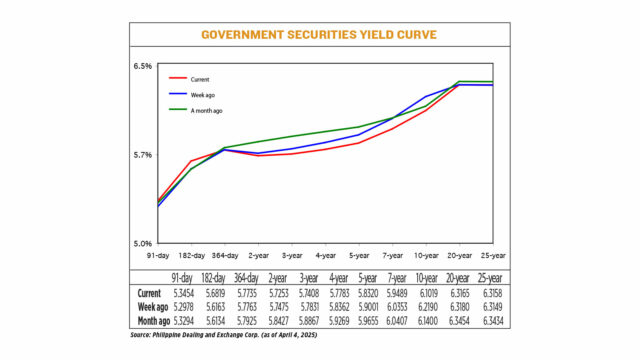
GS yields, which move opposite to prices, went down by an average of 2.58 basis points (bps) week on week, according to the PHP Bloomberg Valuation Service (BVAL) Reference Rates as of April 4 published on the Philippine Dealing System’s website.

Rates at the short end of the curve were mixed, with the 91- and 182-day Treasury bills (T-bill) going up by 4.76 bps (to 5.3454%) and 6.56 bps (5.6819%), respectively. Meanwhile, the 364-day T-bill went down by 0.28 bp to fetch 5.7735%.

At the belly, yields fell across all tenors. The rates of two-, three-, four-, five-, and seven-year Treasury bonds (T-bonds) declined by 2.22 bps (to 5.7253%), 4.23 bps (5.7408%), 5.79 bps (5.7783%), 6.81 (5.8320%) and 8.64 bps (5.9489%), respectively.

At the long end of the curve, yields on the 10- and 20-year T-bonds went down by 11.71 bps and 0.15 bp to 6.1019% and 6.3165 respectively. Meanwhile, the 25-year bond inched up by 0.09 bp to fetch 6.3158%.

GS volume traded amounted to P96.37 billion on Friday, higher than the P40.72 billion recorded a week earlier.

Yields mostly tracked the movement of US Treasuries as the market following the Trump administration’s reciprocal tariff announcement on Wednesday, analysts said, with slower Philippine headline inflation in March also causing GS yields to end lower week on week.

“Government bond yields traded lower by 5-12 bps week on week on the back of lower US rates and the softer-than-expected consumer price index (CPI) for March… The benign inflation print provided clarity for the Bangko Sentral ng Pilipinas’ (BSP) policy meeting, where the central bank is now expected to reduce benchmark rates by at least 25 bps,” Dino Angelo C. Aquino, vice-president and head of fixed income at Security Bank Corp., said in an e-mail.

“The Philippines is not a manufacturing country and is a net importer of goods; hence, these reciprocal tariffs won’t have much of an effect on the overall macroeconomic backdrop. Given the stable currency, benign inflation and the BSP resuming its easing cycle, local bond yields remain biased to move lower,” Mr. Aquino said.

A bond trader said the market is still assessing the tariff situation, with most players taking a wait-and-see stance.

“But overall, this is more of a growth concern for the Philippines than inflation,” the bond trader said.

Financial markets were gripped by recession fears as stocks extended a punishing global sell-off on Friday in the wake of US President Donald J. Trump’s sweeping tariffs, helping drive a rally in US Treasuries and supporting gold near a record peak, Reuters reported.

The frenetic activity in markets came after Mr. Trump on Wednesday announced Washington’s steepest trade barriers in more than 100 years, sparking a scramble among investors for safe havens like government bonds, the yen and gold.

US Treasury yields slid as investors poured into the safe-haven bonds. Bond yields move inversely to prices.

Meanwhile, Philippine headline inflation eased to a near five-year low in March, the government reported on Friday. The consumer price index stood at 1.8% in March, easing from the 2.1% in February and 3.7% a year ago.

This was within the BSP’s 1.7%-2.5% forecast for the month and below the 2% median estimate in a BusinessWorld poll of 18 analysts.

The March print was the lowest in 58 months or since the 1.6% logged in May 2020 at the height of the coronavirus pandemic.

For the first quarter, inflation averaged 2.2%, well within the central bank’s 2-4% target.

Analysts said the slower March inflation print sets the stage for the BSP to resume its easing cycle when it meets to review policy on Thursday.

All 17 analysts in a BusinessWorld poll conducted last week expect the Monetary Board to reduce the target reverse repurchase rate by 25 bps to 5.5% at its April 10 meeting.

This would mark its first easing move since December as the BSP unexpectedly kept benchmark interest rates steady in February in a “prudent” move to assess the potential impact of the Trump administration’s evolving trade policies on the Philippine economy.

The Monetary Board has brought down borrowing costs by a cumulative 75 bps since it began its rate-cut cycle in August last year.

BSP Governor Eli M. Remolona, Jr. last month said there is a “good chance” that the central bank will cut rates by 25 bps at its April 10 meeting, especially if March inflation is better than expected.

Mr. Remolona also signaled potential cuts of 50 to 75 bps for the year.

For this week, the trader said GS yield movements will likely depend on the BSP’s policy decision and the Bureau of the Treasury’s bond auction on Tuesday.

“US payroll numbers may play a factor in this week’s trading, but tariff uncertainties remain the focal point for global markets and global yields. As the trade war intensifies, we may see US rates continue to move lower and local bonds to trade lower in sympathy as well,” Mr. Aquino added. — Lourdes O. Pilar with Reuters


Promoting maternal and child health: Healthy Beginnings, Hopeful Futures

FREEPIK

Every year on April 7, the world pauses to mark World Health Day — a moment to reflect on the progress we’ve made and the challenges that remain in global health. This year’s theme, “Healthy Beginnings, Hopeful Futures,” is a powerful reminder that the well-being of mothers and their children is foundational to the health of any nation.

Yet the reality remains stark.

Each year, nearly 300,000 women die from pregnancy or childbirth-related complications. More than 2 million newborns lose their lives in the first month, and 2 million more are stillborn. That’s one preventable death every seven seconds, according to the World Health Organization (WHO).

These are not just numbers — they are stories of mothers who never got to cradle their babies, of families shattered by loss, and of futures altered forever.

Despite ongoing efforts, the WHO warns that four out of five countries are not on track to meet the 2030 targets for reducing maternal deaths. One in three countries will fall short of their goals for newborn survival.

Behind these statistics lies an urgent call to action.

High-quality, compassionate care must be available to women and families — before, during, and after childbirth. This includes not only addressing obstetric emergencies, but also mental health support, noncommunicable diseases, and access to family planning. Health systems must be responsive to the complex realities of maternal and newborn health.

In the Philippines, we have made important strides. The maternal mortality ratio has improved from 129 per 100,000 live births in 2000 to 78 in 2020. But challenges persist. The estimated infant mortality rate in 2024 — 22 per 1,000 live births — still falls short of the Sustainable Development Goals (SDGs).

To meet these goals, the Department of Health (DoH) is implementing comprehensive strategies like the Integrated Maternal, Neonatal and Child Health and Nutrition Strategy. This program emphasizes skilled birth attendance, emergency obstetric care, and family planning — aiming for 90% of births in healthcare facilities and increased access to antenatal care (ANC).

ANC supports women throughout pregnancy with essential services like medical exams, nutritional and mental health assessments, iron and folic acid supplements, and screening for infections. It’s a critical safeguard for both mother and baby.

Facility-based deliveries (FBD), another cornerstone of the DoH strategy, ensure mothers give birth in safe environments, supported by skilled professionals. This reduces complications and increases survival rates.

Following birth, postnatal care (PNC) is equally vital. It includes immunization for newborns, lactation counseling, mental health screening for mothers, and education on family planning and nutrition. The DoH recommends that every woman receive a health check within two days of delivery — a simple step that can save lives.

Vaccination also plays a pivotal role in protecting mothers and infants. Pregnant women are advised to receive key immunizations such as the flu shot, tetanus-diphtheria (Td), and hepatitis B. After delivery, catch-up vaccinations — including MMR and varicella — can be safely administered to protect both mother and future pregnancies.

But medical care alone is not enough.

Supportive policies and laws are essential in protecting maternal and child health. Legislation such as the Universal Health Care Act, the First 1,000 Days Act, and the Responsible Parenthood and Reproductive Health (RH) Law underscore the country’s commitment to safeguarding the rights and health of women and children.

The research-based biopharmaceutical industry stands with governments, healthcare professionals, and communities in this shared mission. Together, we can end preventable maternal and newborn deaths and build a future where every woman and child have the chance not just to survive — but to thrive.

This World Health Day, let us remember: Every healthy beginning leads to a more hopeful future.


Teodoro B. Padilla is the executive director of Pharmaceutical and Healthcare Association of the Philippines which represents the biopharmaceutical medicines and vaccines industry in the country. Its members are in the forefront of research and development efforts for COVID-19 and other diseases that affect Filipinos.

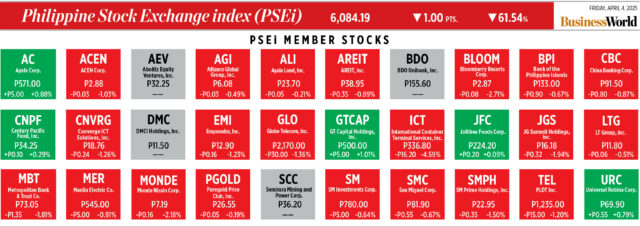
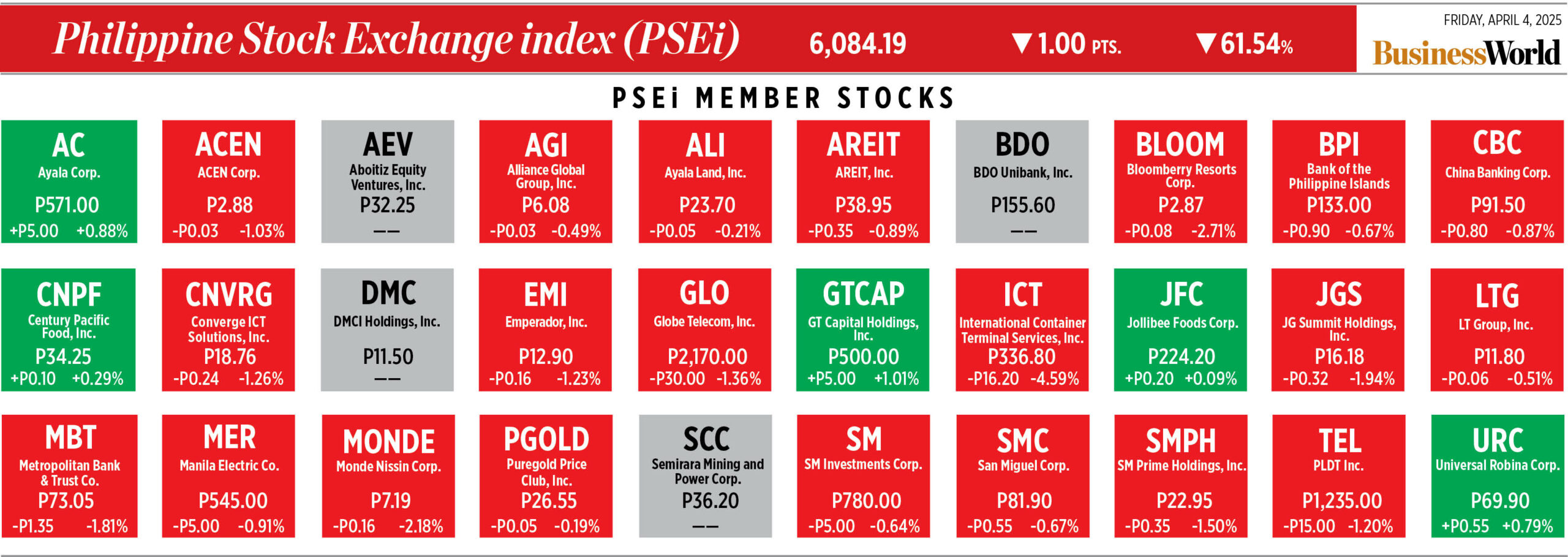
How PSEi member stocks performed — April 4, 2025

Here’s a quick glance at how PSEi stocks fared on Friday, April 4, 2025.


Style (04/07/25)


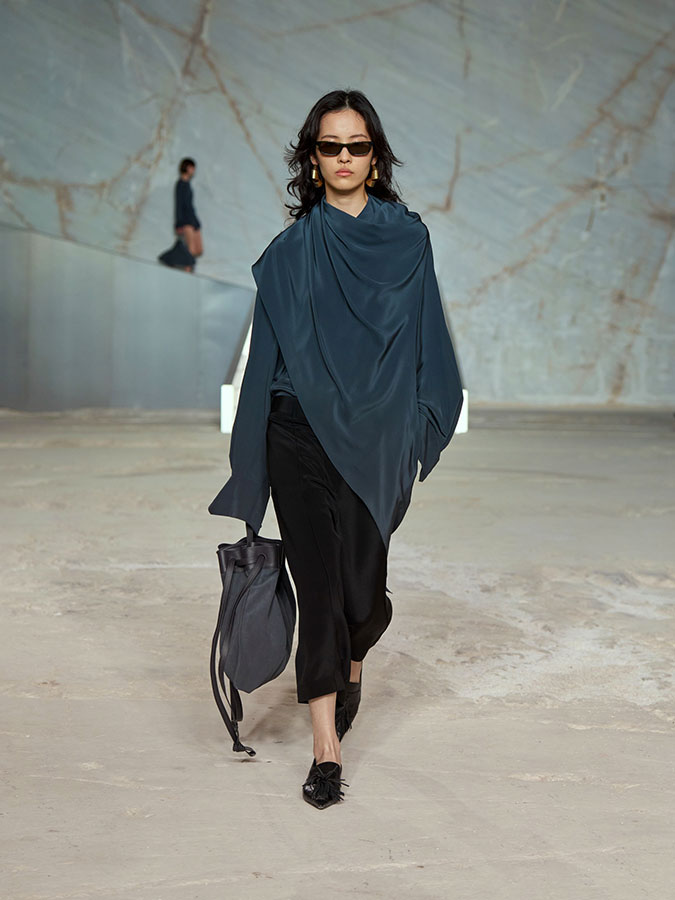
COS debuts spring/summer collection

ON April 2, COS returned to the runway for its first-ever show in Athens, presenting the brand’s Spring Summer 2025 collection. The runway was brought to life within the cavernous Dionyssomarble Quarry. The enveloping marble walls created a striking contrast to the collection’s clean minimalism and sculptural lines. Models descended a steel staircase, looping in and out of the cave, showcasing 35 looks. The collection explores precision in cut and signature detailing. The womenswear features softly sculptured silhouettes and draped elements, while tailoring is reimagined with a deconstructed sensibility. Cascading fabrics create fluidity, and ethereal transparency reveals glimpses of the body. The looks were finished with pointed suede mules, classic ballerinas, and minimalist knitted sock boots. A pared-back utility style in menswear takes center stage, emphasized through functional details. Classic styles are revisited with sleeveless tailoring. There are silk sets and Bermuda shorts offering a refined yet relaxed summer staple. Light summer leather jackets are layered over shirts with soft rib textures. The menswear garments are complemented by soft leather sandals or mule loafers. This season, COS also introduces a unique marbled print inspired by Renaissance paintings, created by pressing flower buds against a lens, capturing a soft blur with delicate details. The seasonal palette is built around off-whites, warm earth tones, and deep brown. Muted blues transition into rich navy, while soft terracotta adds vibrancy to womenswear. A classic shirt style is crafted from Materra Hydroponic Cotton — cotton grown in an indoor environment with controlled application of water and nutrients without the need for arable land or conventional irrigation. A selection of the show items is available immediately at COS stores and on cos.com.


Uniqlo opens new Imus roadside store

UNIQLO extends its reach south of Manila by opening its newest roadside store in the City of Imus, Cavite. The new store is found along the stretch of Aguinaldo Highway. It offers an expanded selection of LifeWear items for the entire family, while having access to a dedicated parking facility. Other features that are staples for all roadside stores across the country include PWD-friendly passageways, and app-to-in-store services such as Click and Collect for faster transactions. There are a number of promos marking the opening, including a free Uniqlo toiletry bag for shoppers with a minimum single-receipt purchase of P3,000 made between April 4 and 10. To avail of the item, customers must download the Uniqlo app and register as a member upon purchase. From April 4 to 10, shoppers at the Imus roadside store can get a free snack from Oishi by presenting a receipt at no minimum purchase, alongside their Uniqlo App Membership ID. The redemption period runs until June 9. The first 100 customers to queue at the new store will receive a free classic ensaymada from Baloy’s from April 11 to 13. There will also be a round of the popular Japanese capsule game, gachapon, featuring different prizes. Customers with a single-receipt purchase are entitled to play the game once for a chance to win a free voucher from select brand partners. Customers must be a registered member of the Uniqlo PH app to enter the promotion, running from April 11 to 13. Visit www.uniqlo.com/ph/en/ to learn more about Uniqlo Imus Roadside Store, #UniqloPH and #LifeWear.


Rustan’s releases summer promos

INDULGE in luxury at Rustan’s Beauty Source and unlock exclusive Rustan’s Beauty Addict member perks. Spend P30,000 and take home an Aranáz Theresa Mini Bag. The promo is ongoing until April 30. Meanwhile, every P5,000 spent at Rustan’s Beauty Source brings the customer closer to a vacation. Beauty Addict members have the chance to win a four-day, three-night stay for two at the exclusive North One Villa in Banwa Private Island, complete with roundtrip flights. Rustans.com partners with Joel’s Place from April 4 to 30. Indulge in a gelato or a summer drink at Joel’s Place and get a P500 Rustans.com gift voucher with a single-receipt spend of P5,000 and above online. From April 5 to 12, get three times more FSP Points when you purchase any regular-priced items at Joel’s Place in Glorietta 4. The Moments of Summer promos are ongoing at Rustan’s Makati, Shangri-La, Alabang, Gateway and Cebu.


Banana Republic goes White (Lotus, that is)

BANANA REPUBLIC, a Gap Inc. brand, in partnership with Warner Bros. Discovery Global Consumer Products, debuts an exclusive capsule collection inspired by HBO’s Emmy-winning TV series, The White Lotus. This limited-edition collection channels the show’s signature escapism and intrigue. “Our heritage, rooted in travel, meets the world of The White Lotus with a thoughtfully crafted collection that is both aspirational and attainable,” said Meena Anvary, head of marketing for Banana Republic. Taking its cues from the series’ third season, set in Thailand, The White Lotus x Banana Republic 24-piece collection features ultra-packable men’s and women’s apparel and accessories with rich hues of turquoise, navy, red, and yellow, alongside graphic prints and fluid silhouettes. It features premium fabrics such as sustainable European flax linen (pre-washed for a lived-in softness), lightweight cotton poplin, and 100% silk. From lightweight knits to relaxed, resort-ready pieces, the collection allows customers to embrace an adventurous mindset. The marketing campaign features The White Lotus Season 3 cast member Patrick Schwarzenegger alongside model, podcast host, and The White Lotus aficionado Shanina Shaik. The Banana Republic x The White Lotus collection is currently available in the Philippines exclusively at bananarepublic.com.ph.

Stocks may rebound with BSP likely to cut rates

BW FILE PHOTO

PHILIPPINE STOCKS may rebound this week as the Bangko Sentral ng Pilipinas (BSP) is expected to cut benchmark interest rates following slower-than-expected March headline inflation.

On Friday, the bellwether Philippine Stock Exchange index (PSEi) fell by 1% or 61.54 points to close at 6,084.19, while the broader all shares index declined by 0.57% or 20.97 points to 3,643.44.

Week on week, the PSEi dropped by 1.03% or 63.25 points from its 6,147.44 finish on March 28, marking its fourth consecutive week in the red.

“US President Donald J. Trump’s ‘Liberation Day’ tariffs hit capital markets, fanning global risk-off sentiment, and eclipsing the 1.8% Philippine inflation in March,” online brokerage 2TradeAsia.com said in a market note.

“The bearish sentiment was sustained in last week’s trading as the US unveiled its reciprocal tariffs, which are expected to have a negative effect on the global economy… Trading has been anemic, reflecting the weak market confidence amid the global downside risks,” Philstocks Financial, Inc. Senior Research Analyst Japhet Louis O. Tantiangco said in a Viber message.

On Thursday, Mr. Trump announced sweeping tariffs as part of his Liberation Day plan that seeks to protect US production, imposing a 10% baseline tariff on all imports and higher targeted duties on dozens of countries. An annex document to the executive order on the tariffs showed an 18% reciprocal tariff for the Philippines.

For this week, Mr. Tantiangco said the PSEi may rebound on bargain hunting.

“Expectations that the BSP will cut policy rates in their upcoming meeting following the further decline in inflation last March may give sentiment a boost,” he said. “However, the global economic concerns amid the US’ tariff policies are still expected to weigh on the market, tempering the potential rise next week. Shocks in the form of new tariff announcements from the US pose downside risks that may pull the market lower.”

Mr. Tantiangco put the PSEi’s support at 6,000 and resistance at 6,400.

Philippine headline inflation eased to 1.8% in March from 2.1% in February and 3.7% a year ago.

This was within the BSP’s 1.7%-2.5% forecast for the month and below the 2% median estimate in a BusinessWorld poll of 18 analysts.

Analysts said the slower March inflation print gives the BSP ample room to resume its easing cycle when it meets to review policy on Thursday. All 17 analysts in a BusinessWorld poll conducted last week expect the Monetary Board to reduce the target reverse repurchase rate by 25 basis points to 5.5% at its April 10 meeting.

Meanwhile, Rizal Commercial Banking Corp. Chief Economist Michael L. Ricafort placed the PSEi’s support at 6,000 and resistance at 6,275 to 6,530.

For its part, 2TradeAsia.com pegged support at 6,000 and resistance at 6,400. — Revin Mikhael D. Ochave

Peso may stay at P56:$1 level

BW FILE PHOTO

THE PESO is likely to stay at the P56-per-dollar level this week as the Bangko Sentral ng Pilipinas (BSP) is widely expected to resume its easing cycle.

On Friday, the local unit closed at P56.821 per dollar, jumping by 27.4 centavos from its P57.095 finish on Thursday, Bankers Association of the Philippines data showed.

This was the peso’s strongest finish in six months or since it closed at P56.295 on Oct. 4, 2024.

Week on week, the peso rose by 56 centavos from its P57.381 finish on March 28.

“The peso strengthened on dollar selling across the board amid growing market concerns after US President Donald J. Trump announced tariffs and after the ISM’s (Institute for Supply Management) manufacturing PMI (purchasing managers’ index) data overnight,” a trader said by phone interview.

The local unit surged as the dollar declined to new lows on Friday due to lower global crude oil prices and US Treasury yields, Rizal Commercial Banking Corp. Chief Economist Michael L. Ricafort said in a Viber message.

In the Asian session early on Friday, the US dollar sank and the safe-haven yen strengthened towards a six-month peak, as traders weighed the fallout from Mr. Trump’s aggressive and far-reaching new tariff measures, Reuters reported

The dollar slipped toward a six-month trough against the euro prior to the release of a crucial monthly US payrolls report later in the day that will offer clues to the health of the economy and the outlook for monetary easing.

Traders now predict four quarter-point interest rate cuts from the Federal Reserve in the remainder of this year, and reduced the odds of further Bank of Japan tightening to almost nil.

Shockwaves from Mr. Trump’s harsher-than-expected tariffs were still rippling through markets more than 24 hours after being unveiled.

Stocks took the brunt of a searing sell-off, driving investors to the safety of assets such as bonds and gold on fears that a full-blown trade war could trigger a global slowdown and stoke inflation.

The dollar had already been on the back foot this year after initial euphoria over Mr. Trump’s policy agenda turned into worry that his focus on trade barriers could lead to stagflation, or even a US recession.

The dollar index, a measure of the currency against a basket of six major peers, plunged 1.9% on Thursday, its worst day since November 2022, and was down a further 0.3% in the latest session.

Mr. Trump said he would impose a 10% baseline tariff on all imports to the United States and higher duties on some of its biggest trading partners, including a rate of 20% on the European Union (EU) and a rate of 24% on Japan.

China now faces combined duties of some 64%, when also factoring in a tariff of 10% that Mr. Trump levied in his first presidential term.

Both China and the EU vowed countermeasures, raising the risk of a broader trade war.

Later on Friday, the US dollar rose against major currencies after Federal Reserve Chairman Jerome H. Powell acknowledged the repercussions of larger-than-expected US tariffs and signaled a cautious tone on future easing.

Mr. Powell said tariffs increased the risk of higher inflation and slower growth, highlighting the difficult path ahead for policy makers at the US central bank.

Mr. Powell’s comments followed data earlier in the day showing that nonfarm payrolls rose by 228,000 jobs last month after a downwardly revised 117,000 rise in February, well above the 135,000 forecast. The unemployment rate ticked up to 4.2% from 4.1%.

The dollar index rose 0.71% to 102.72 in afternoon trading on Friday.

For this week, the trader said the market will likely react to the US nonfarm payrolls report, with the BSP’s policy meeting on Thursday also expected to be a key trading driver.

All 17 analysts in a BusinessWorld poll expect the Monetary Board to cut its policy rate by 25 basis points (bps) to 5.5% at its April 10 meeting.

This would mark its first easing move since December as the BSP unexpectedly kept benchmark interest rates steady in February to assess the potential impact of the Trump administration’s policies on the Philippines. The Monetary Board has brought down borrowing costs by a cumulative 75 bps since it began its rate-cut cycle in August last year.

BSP Governor Eli M. Remolona, Jr. last month said there is a “good chance” that the central bank will cut rates by 25 bps at its April 10 meeting, especially if March inflation is better than expected. He also signaled cuts of 50-75 bps for this year.

The trader sees the peso moving between P56.60 and P57 per dollar this week, while Mr. Ricafort expects it to range from P56.60 to P57.10. — A.M.C. Sy with Reuters