Home Blog Page 1270

Group hits CSC memo barring gov’t workers from political discourse

PHILIPPINE STAR/ MIGUEL DE GUZMAN

A POLITICAL GROUP on Thursday criticized a Civil Service Commission (CSC) order prohibiting government workers from participating in online political discourse, calling it a violation of free expression.

Bayan Muna and the Confederation for Unity Recognition and Advancement of Government Employees (COURAGE), a union of government employees, will campaign for the order’s revocation, said Ferdinand R. Gaite, the union’s adviser and Bayan Muna’s party-list candidate for the midterm elections.

“Preventing government employees from expressing their views on political issues in social media, especially on policies and politicians affecting their rights and welfare as government workers, is curtailing their rights to freedom of expression as workers and as citizens,” he said in a statement.

The CSC in late March barred government workers from engaging in “partisan political activities,” including liking or following political candidates’ online content.

“This recent issuance of the CSC… about political matters is too much! It tramples upon the very rights that civil servants are supposed to uphold and defend,” said Mr. Gaite. — Kenneth Christiane L. Basilio

Philippine, US troops hold seaside war drills in BARMM

DATU BLAH SINSUAT, Maguindanao del Norte — Filipino and American soldiers held in a seaside village where an amphibious sea-to-shore anti-terror assault drill and an artillery fire exercise on Wednesday, in the presence of local officials from Bangsamoro towns around.

The activity was part of the Marine Exercise 2025, organized by the Philippine Marine Corps and its US counterpart, which was launched in the upland Barira town in Maguindanao del Norte almost two weeks ago.

It also involved the Army’s 6th Infantry Division, the Philippine Coast Guard, and the Police Regional Office-Bangsamoro Autonomous Region in Muslim Mindanao (PRO-BARMM).

American and Filipino soldiers used small, but high-speed watercraft in their beachfront combat drill, capped off with a simulated presence of terrorists at the shores of Barangay Penansaran, which is home to mixed Maguindanaon and ethnic non-Muslim Teduray villagers.

Also present in the event at Barangay Penansaran were ranking officials of the Western Mindanao Command led by its commander, Army Lt. Gen. Antonio G. Nafarrete, and representatives from the Naval Forces Western Mindanao and the Philippine Army Artillery Regiment.

“We are grateful to the municipal government of Datu Blah Sinsuat and its local chief executive for helping push this activity forward,” Mr. Nafarrete said, referring to Mayor Marshall I. Sinsuat, the chairperson of their multi-sector Municipal Peace and Order Council.

Mr. Nafarrete said the commander of the Philippine Navy’s 1st Marine Brigade, Brig. Gen. Romulo Quemado, and Army Major Gen. Donald Gumiran of the 6th Infantry Division, cooperated in helping oversee the exercise. — John Felix M. Unson

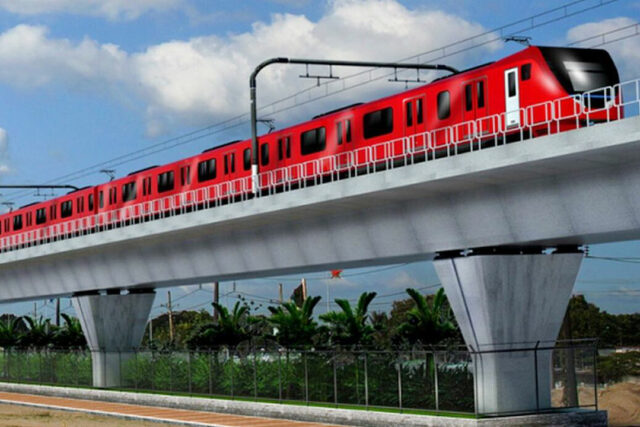
Up to four-year delay seen for North-South rail project

JICA

THE Department of Transportation (DoTr) said full operations for the North-South Commuter Railway (NSCR) will likely be four years delayed after hitting a 50% completion rate to date for the Manila-Clark segment.

“The estimate of our Japanese partners is a four-year delay. Our initial target completion date is 2027 for the full line to be operational,” Transportation Secretary Vivencio B. Dizon said in a radio interview Thursday.

In a separate briefing, Mr. Dizon said the DoTr is hoping that a segment of the NSCR will be operational by 2027.

“The NSCR is roughly at a little over 50% complete from Manila to Clark but we are confident that we can still run the Manila to Malolos by the end of 2026 or maybe early 2027… We will see these trains start to operate within the term of the President, not the full line but I think the line from Manila to Malolos,” he said.

The 147-kilometer NSCR will connect Malolos, Bulacan with Clark International Airport, and Tutuban, Manila with Calamba, Laguna. The P873-billion project is co-financed by the Japan International Cooperation Agency (JICA) and the Asian Development Bank. It will have 35 stations and three depots.

“In fact, the trains are ready for delivery this year. However, the delays are due to civil works, and construction,” Mr. Dizon noted.

Once fully operational, the NSCR is projected to reduce travel time between Clark and Calamba to two hours, against the current four to 4.5 hours.

The DoTr has said that big-ticket railway projects will face major right-of-way acquisition issues.

The Department of Justice (DoJ) has issued a legal opinion that compensation rules set by development partners for persons displaced by foreign-funded projects apply only if the loan agreement was signed prior to the effectivity of the Right-of-Way Act (Republic Act No. 10752).

The opinion was issued to clarify the compensation rules governing projects entered into by the DoTr and entities like the JICA. — Ashley Erika O. Jose

Palay floor price scheme under study after farmers propose P20 per kilo

A farmer threshes newly harvested palay grains at a ricefield in Mogpog, Marinduque in central Philippines, March 22, 2016. — REUTERS

THE Department of Agriculture (DA) signaled its openness to a proposal for a minimum buying price for palay (unmilled rice) to be set at P20 per kilogram.

Agriculture Assistant Secretary Arnel V. de Mesa said the DA is open to and studying a floor price mechanism, and described the floor price of P20 per kilo for dry palay proposed by the Federation of Free Farmers (FFF) as reasonable.

The FFF on Thursday said a minimum palay buying price will shield producers from “severe” drops in farmgate prices as domestic rice faces competition from imports.

Buying prices for freshly harvested palay have dropped to as little as P12-14 per kilo in parts of the country. “At this rate, many farmers will end up with losses, while more efficient producers will net only about P16,000 per hectare, or P2,700 per month for six months’ work,” the FFF said.

The FFF said the maximum suggested retail price for consumers should be accompanied by protections for farmers, calling for traders to be required to buy palay at a minimum price.

A floor price scheme is needed because the National Food Authority (NFA) can absorb only 4-5% of the harvests due to funding, storage and other constraints, the FFF said.

It said many farmers are forced to sell to private traders because they cannot comply with the NFA’s drying and quality standards.

The NFA’s buying price is P24 per kilo for dry and clean palay and at P18 per kilo for fresh palay, the DA said in mid-March.

The FFF said the floor price scheme could complement a proposed seasonal tariff arrangement, under which duties on rice imports are temporarily raised during the harvest and returned to normal afterwards.

Rice imports fell 46% year on year to 641,000 metric tons (MT) in the year to date ending March 13.

The DA said 96,260 MT of the shipments arrived in March, 267,114 in February, and 277,540 in January. The equivalent year-earlier volumes are 429,260 MT in January, 341,585 in February, and 415,764 in March.

In 2024, rice imports hit a record 4.68 million MT (MMT), against 3.6 MMT a year earlier. — Kyle Aristophere T. Atienza

Soybean meal imports rising on hog recovery

REUTERS

PHILIPPINE soybean meal imports will likely increase 3.1% to 3.35 million metric tons (MMT), according to the US Department of Agriculture (USDA), to accompany an expected rebound in the hog industry.

The increase in imports for marketing year 2025/26 is also driven by increasing demand from the broiler, layer,aquaculture, and pet food segments, the USDA said in a report, citing its Foreign Agriculture Service.

It also noted expectations of a “gradual rebound in the swine industry.”

The US accounts for 80% of the Philippines’ soybean meal imports.

BusinessWorld has reported that the Philippine poultry industry is expecting feed prices to fall as US producers seek new markets after being shut out of China by retaliatory tariffs.

China, which is now facing a 104% charge on its exports to the US, has announced retaliatory tariffs of 84% on all US goods.

Soybean meal makes up between 5% and 30% of the composition of feed sold in the Philippines, the report noted, with demand from the broilers and aquaculture industries accounting for 25-30%.

The USDA report said domestic soybean production will likely remain under 1,000 MT in 2025/26.

The USDA said Philippine imports of soybean will increase 2.1% year on year to 147,000 MT in MY 2025/26 to meet the increasing demand from food and beverage processors, specifically for soy sauce and soy drinks.

It said soybean crushing demand for MY 2025/26 will remain flat, noting that the Philippines has only one crushing facility for processing imported soybeans into oil and meal.

Meanwhile, demand for soybeans for food use will rise 2.9% to 71,000 MT in MY 2025/26 due to increase in population, rising household incomes, and healthy eating trends.

Soybeans are processed into various food products such as soymilk, soy sauce, soy oil, tofu, bean curd, and fermented soybean.

“There is rising awareness among the consumers in the Philippines on the health benefits of soy products, specifically soymilk, that appeals to the health-conscious consumers,” the report said.

The US remains the largest soybean supplier, with 85% of the market in MY 2023/24, followed by Canada (7%) and Argentina (8%). The remaining suppliers in MY 2023/24 were China, Malaysia, and Singapore (with a combined 1% market share). — Kyle Aristophere T. Atienza

High prices dampen mom-and-pop store sales of alcohol, cigarettes

BW FILE PHOTO

CIGARETTES and liquor sales by mom-and-pop neighborhood outlets, also known as sari-sari stores, declined last year due to increasing prices, according to tech startup Packworks, which makes applications helping micro-retailers manage their businesses.

Citing sales transactions from its network of 300,000 sari-sari stores, Packworks said sales dropped last year of cigarette brands Marlboro, Mighty, and Winston, as well as Tanduay rum and Emperador brandy.

“Combined sales of the three cigarette brands fell approximately 22% in 2024 at over P392 million in gross merchandise value (GMV),” Packworks said.

“Mighty recorded a marked decrease of 25%, followed by Marlboro at 24% and Winston at 8%,” it added.

According to Packworks, sari-sari stores saw a decline in cigarette sales even after the floor price of cigarette packs fell to P78.58 in 2024 from P114.6 in 2023.

“Consumers’ purchasing power was weakened by high inflation,” it added, noting inflation was 3.2% at the end of 2024.

Sales of Tanduay rum declined 17% to P102 million last year. Emperador brandy sales were down 22% at P49 million.

Packworks Chief Data Officer Andoy Montiel said  the decrease in cigarette and liquor sales point to signal impending changes in consumer preferences.

He cited “various external factors such as rising prices and supply issues” which “might also be a precursor to changing internal consumer behaviors and preferences.” — Justine Irish D. Tabile

PHL banking on halal to cushion US tariff blow

FREEPIK

THE Department of Agriculture (DA) said new markets for Philippine farm exports, including halal-certified products, will help mitigate the uncertainty generated by the US tariffs.

Agriculture Secretary Francisco Tiu Laurel, Jr. has been pursuing negotiations to widen the access of Philippines farm exports, DA spokesman and Assistant Secretary Arnel V. de Mesa said at a briefing.

Currently, the Philippines is working to boost its halal exports to the Middle East, he said, while targeting Italy and Spain among European markets.

Mr. De Mesa noted that Mr. Laurel has also visited Japan and South Korea to seek lower tariffs for Philippine agriculture products.

He said the Japanese government has agreed to review — and potentially lower —tariffs imposed on Philippine bananas, which are charged an 18% duty between April 1 and Sept. 30 and 8% between Oct. 1 and March 31 under the Japan-Philippines Economic Partnership Agreement (JPEPA).

Mr. De Mesa reitared that the 17% tariff to be imposed by the US on Philippine goods will not have a major impact on domestic agriculture.

After the US, Japan and China are the next largest markets for Philippine exports, he noted

“Also, our goods are exported to many Asian markets,” he said in Filipino.

The US, which accounts for about 17% of total Philippine agricultural trade, has paused its plan to impose additional tariffs on most countries except China.

In Southeast Asia, Cambodia faces the steepest tariff at 49%, followed by Laos (48%), Vietnam (46%), Myanmar (44%), Thailand (36%), Indonesia (32%), Malaysia (24%) and Brunei (24%). Singapore will be imposed a baseline tariff of 10%. — Kyle Aristophere T. Atienza

Budget releases nearly 81% at end of March

BW FILE PHOTO

THE Department of Budget and Management (DBM) said 80.7% of the 2025 national budget has been disbursed as of the end of March.

According to its Status of Allotment Releases report, the DBM said it released P5.11 trillion of the P6.326-trillion budget, with a P1.22-trillion balance.

The release rate was behind the 83.2% pace at the end of March 2024.

Of the released funds, P3.43 trillion went to government agencies and departments, leaving P540 billion still undisbursed.

The Department of Public Works and Highways received P1.11 trillion or 96.6% of its P1.09 trillion allotted funds.

Meanwhile, Special Purpose funds releases amounted to P246.76 billion.

Automatic appropriations release totaled P1.39 trillion, with a P719.79 billion balance.

These included P1.03 trillion for the National Tax Allotment, P152.88 billion for interest payments, P83.42 billion for the Block Grant, and P75.59 billion for government agencies’ retirement and life insurance premiums.

Unprogrammed appropriations (UA) worth P7.51 billion were also released.— Aubrey Rose A. Inosante

Developers urged to allocate more space to favor pedestrian traffic

INTERAKSYON — FACEBOOK/MACKY FERNANDO

DEVELOPERS need to allocate more space to ensure commuter safety and promote inclusive mobility, mobility advocates said.

“The land use plan only allocates, as per our HLURB (Housing and Land Use Regulatory Board) guidelines, 30% for open spaces for a big parcel of land,” Jose Ramon Carunungan, principal architect at Carunungan & Partners Co., told BusinessWorld on the sidelines of a briefing Thursday.

“I think we have to look into increasing (open spaces) so we can prioritize pedestrians instead of vehicles” he said, citing Presidential Decree No. 1216.

“A proper land use plan will also ensure that important services are accessible and within a reasonable commuting distance,” Move As One Coalition Co-convenor Robert Y. Siy, Jr. said after the briefing.

“There are many different approaches to working out a proper land use arrangement, but what’s important is that there should be a right fit between transportation and land use.”

Some 94% of Filipinos commute, while only 6% own four-wheeled vehicles, according to a 2022 survey by the Social Weather Stations.

Commuters face inconveniences like narrow sidewalks, car-centric infrastructure, and the lack of inclusive mobility infrastructure especially for the elderly and persons with disabilities (PWD).

About 35% of all fatal crashes in Metro Manila involve pedestrians, according to Antonio Pagulayan, who heads the traffic education unit of the Metro Manila Development Authority.

“In road safety, we do not call these catastrophic events ‘accidents’ or ‘mishaps,’ because a road crash occurs as a result of risks ignored and bad decisions made,” Dinna Louise C. Dayao, communications consultant at Move As One Coalition, said at the briefing.

The Philippines loses about $11 billion from deaths and injuries caused by road crashes, the Asian Transport Observatory reported.

Mr. Siy also called Metro Manila’s footbridges “hostile infrastructure,” citing the recent death of a 75-year-old PWD who died of a brain hemorrhage after slipping on the stairs of a footbridge.

Maureen Ava Mata, accessibility and inclusivity co-convenor at the Move As One Coalition, said inclusivity is an afterthought during fatal accidents involving pedestrians.

She also called for the full implementation of the Accessibility Law to ensure PWDs have more mobility options. — Beatriz Marie D. Cruz

Peso slips vs dollar as BSP resumes easing cycle

BW FILE PHOTO

THE PESO slipped against the dollar on Thursday as players took positions following the Bangko Sentral ng Pilipinas’ (BSP) move to resume its easing cycle.

The local unit closed at P57.35 per dollar on Thursday, weakening by four centavos from its P57.31 finish on Tuesday, Bankers Association of the Philippines data showed.

The peso opened the session sharply stronger at P57.18 against the dollar. Its worst showing was at P57.355, while its intraday best was at P57.14 versus the greenback.

Dollars exchanged went down to $1.48 billion on Thursday from $1.97 billion on Tuesday.

“The dollar-peso initially traded higher on improving risk sentiment after US President Donald J. Trump announced the 90-day tariff pause,” a trader said in a phone interview.

“However, it [dropped] on expectations that the BSP will cut rates, which it did, and after the BSP signaled further rate cuts for the rest of the meetings,” the trader added.

The peso’s rally lost steam as players positioned before the BSP’s announcement of its policy decision later in the session, Rizal Commercial Banking Corp. Chief Economist Michael L. Ricafort likewise said in a Viber message.

The Monetary Board on Thursday cut benchmark interest rates by 25 basis points (bps) to bring the policy rate to 5.5%, as expected by all 17 analysts in a BusinessWorld poll.

BSP Governor Eli M. Remolona, Jr. said expectations of easing inflation support the shift to a more accommodative monetary policy stance.

He added that the Monetary Board is considering further rate cuts but maintained that these will be delivered in “baby steps” of 25 bps at a time.

“For now, what we’re looking at is a few more cuts, but we have more meetings than the number of cuts we are thinking about,” Mr. Remolona said.

The Monetary Board has four meetings left this year, which are scheduled for June 19, Aug. 28, Oct. 9, and Dec. 11.

For Friday, the trader expects the peso to move between P57.10 and P57.50 per dollar, while Mr. Ricafort sees it ranging from P57.25 to P57.45. — Aaron Michael C. Sy

Stocks climb as Trump pauses reciprocal tariffs

BW FILE PHOTO

PHILIPPINE STOCKS climbed on Thursday as the United States suspended the implementation of most “reciprocal” tariffs it had imposed on its trading partners.

The benchmark Philippine Stock Exchange index (PSEi) rose by 1.19% or 71.48 points to close at 6,077.82, while the broader all shares index increased by 1.12% or 40.14 points to end at 3,622.94.

“The market closed higher on the back of a relief rally in reaction to President Donald J. Trump’s decision to temporarily pause most reciprocal tariffs, including those on the Philippines,” China Bank Capital Corp. Managing Director Juan Paolo E. Colet said in a Viber message.

“The benchmark index opened strongly in the morning, but some of those gains melted away over the trading session as investors took profits and trimmed positions to hedge against the escalating trade war between the US and China. Nonetheless, market optimism was partly sustained by traders placing bets that the Bangko Sentral ng Pilipinas (BSP) would cut its policy rate,” he added.

Mr. Trump said he would temporarily lower the hefty duties he had just imposed on dozens of countries while further ramping up pressure on China, sending global stocks rocketing higher, Reuters reported.

The turnabout on Wednesday came less than 24 hours after steep new tariffs kicked in on most trading partners.

A 10% blanket duty on almost all US imports will remain in effect, the White House said.

Meanwhile, the Monetary Board on Thursday cut benchmark interest rates by 25 basis points, the BSP announced at the stock market’s close. This brought the policy rate to 5.5%.

“The PSEi rose this Thursday, taking cues from Wall Street’s rally overnight. The local market continued with its run as investors appreciated Mr. Trump’s move to temporarily drop tariff rates for most of its trading partners with higher tariffs to 10% to give room for negotiations,” Philstocks Financial, Inc. Senior Research Analyst Japhet Louis O. Tantiangco said in a Viber message.

Overnight, the Dow Jones Industrial Average surged by 7.87% or 2,962.86 points to 40,608.45; the S&P 500 went up by 9.52% or 474.13 points to 5,456.90; and the Nasdaq Composite climbed by 12.16% or 1,857.06 points to 17,124.97.

At home, all sectoral indices closed higher. Mining and oil surged by 6.44% or 561.79 points to 9,276.33; holding firms climbed by 3.76% or 184.15 points to 5,074.22; industrials went up by 1.27% or 107.55 points to 8,545.6; property increased by 1.08% or 23.50 points to 2,181.57; financials rose by 0.11% or 2.83 points to 2,373.37; and services inched up by 0.01% or 0.25 point to 1,916.63.

Value turnover surged to P13.31 billion on Thursday with 951.3 million shares traded, from the P6.42 billion with 1.22 billion issues exchanged on Tuesday.

Advancers outnumbered decliners, 129 versus 72, while 46 names were unchanged.

Net foreign selling went down to P110.26 million on Thursday from P427.75 million on Tuesday. — Revin Mikhael D. Ochave with Reuters


Smart scores big with NBTC, shapes future of PHL basketball

THE SMART-NBTC NATIONAL FINALS, supported by Smart Sports and Puso Pilipinas, featured thrilling matches that captivated basketball fans nationwide.

MOBILE services provider Smart Communications, Inc. (Smart) successfully concluded the 2025 Smart-National Basketball Training Center (NBTC) National Finals. This year’s event brought together the best Filipino high school basketball teams, both local and international, to compete for the championship title, showcasing the exceptional talent and dedication of young athletes from across the country.

The Smart-NBTC National Finals, supported by Smart Sports and Puso Pilipinas, featured thrilling matches that captivated basketball fans nationwide. All games were livestreamed on PusoP.Com, allowing fans to watch their favorite teams and players in action.

Jude Turcuato, PLDT and Smart Head of Sports, expressed his pride in the continued partnership with NBTC. “Smart is committed to empowering young athletes from the grassroots level. Through our support for the NBTC, we aim to provide these talented individuals with the resources and opportunities they need to excel in their sport and achieve their dreams. The success of the 2025 Smart-NBTC National Finals is a testament to our dedication to nurturing the next generation of Filipino basketball stars.”

In an interview with Puso Pilipinas, former Los Angeles Lakers shooting guard and NBA coach Byron Scott spoke about his experience coaching young athletes in this year’s NBTC. “The passion here in the Philippines about basketball is unmatched. It really is something special to watch, they play it with such a passion, and they play so hard, and they have very high basketball IQs, too. It’s really good to see the revolution of basketball here from when I was here eight to ten years ago till now has really developed.”

The NBTC has a rich history of producing prominent names in basketball, including Houston Rockets guard Jalen Green, Gilas Pilipinas center Kai Sotto, Kamaka Hepa, Kihei Clark, Jeron Artest, Kai Ballungay, Jared Bahay, and Kieffer Alas. Their participation in previous NBTC tournaments highlights the event’s significance in developing future basketball talents. Also present at the finals is Filipino-American comedian Jo Koy, who sponsored Fil-Nation Jo Koy, an under-19 girls squad in the finals.

Smart remains steadfast in its mission to promote sports development and inspire young athletes to reach their full potential. All these initiatives highlight PLDT and Smart’s continuing contribution to the United Nations Sustainable Development Goals (SDGs), particularly SDG 3: Good Health and Well-Being.