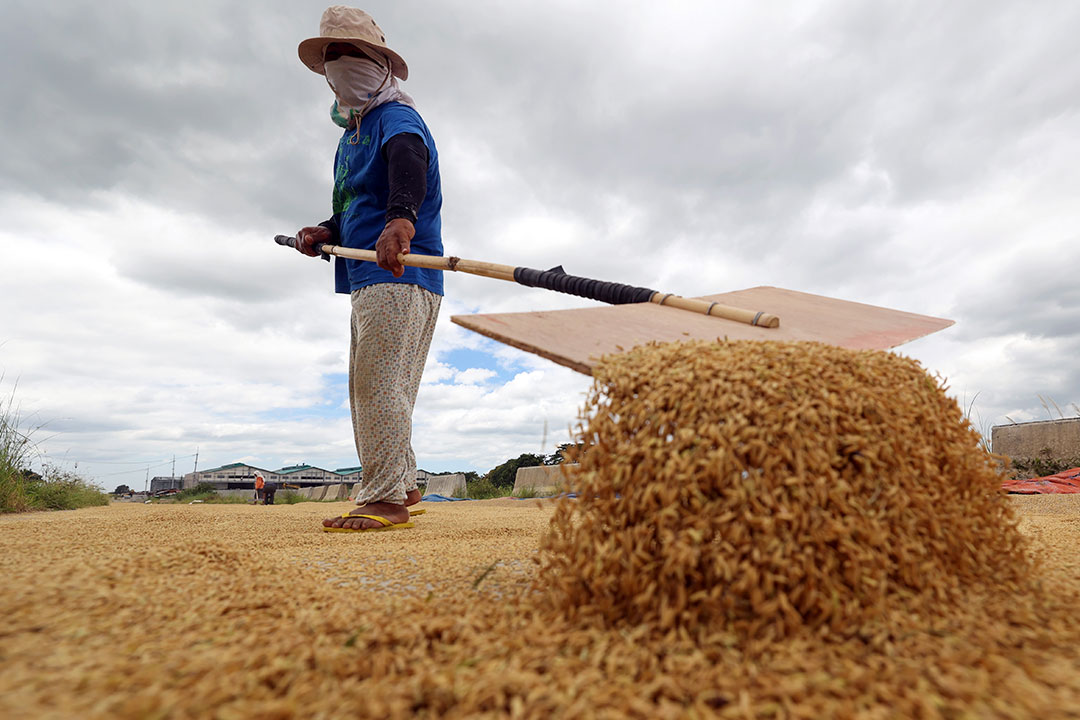
THE National Food Authority (NFA) said it is considering a “slight increase” in its buying price for palay (unmilled rice) by the end of March to replenish rice stocks during the dry-season harvest.
NFA Administrator Larry R. Lacson said the grains agency is struggling to compete with the high prices offered by private traders.
“Right now, traders are buying at very high prices, so we cannot keep up,” Mr. Lacson told reporters late Monday.
The Philippine Statistics Authority (PSA), citing preliminary data, reported that the farmgate price of dry palay rose 10.4% year on year in February to a national average of P22.47 per kilo, with prices reaching as high as P28.12 per kilo in the Cagayan Valley.
The NFA currently buys palay at P21 per kilo for dry palay and P17 per kilo for fresh palay.
Mr. Lacson described the planned new buying price as slightly higher, but declined to provide a specific range, citing the need to discourage speculation.
He said the NFA has deliberately avoided raising its buying price for now to avoid costs from being passed on to the retail level.
The possible price change could take effect towards the end of March, when the harvest is nearing its peak, Mr. Lacson said.
“For now, prices are very good, and we want our farmers to enjoy that because they incurred losses previously. We may just step in toward the end of the peak of the harvest,” Mr. Lacson said.
He said the planned increase in buying price would allow the NFA to compete with private traders and procure a “sizable amount of palay to replenish stocks” that have already been released.
The NFA said it is also seeking temporary authority to sell rice directly to consumers as prices of the staple continue to rise.
Currently, the grains agency can only dispose of its stocks through public auctions and the P20-per-kilo rice program, under which state-run Food Terminal, Inc. (FTI) purchases rice and distributes it through Kadiwa stores and other designated outlets.
If granted approval, Mr. Lacson said the NFA plans to sell rice at P33 per kilo, the same price it charges FTI.
Meanwhile, the NFA assured the public that rice supply remains sufficient despite longer queues reported at outlets selling subsidized rice for the government’s P20-per-kilo program.
“Our message to the public is not to worry. We have enough supply. There is no need to (rush to line up) just to buy P20 rice,” Mr. Lacson said.
Mr. Lacson said the NFA currently holds about 2.6 million bags of milled rice in inventory. Of this, around 600,000 bags have been sold through auctions and are expected to enter the market soon.
He said the remaining two million bags in stock are being used to supply the P20 rice program, while milling operations continue to replenish supply.
Mr. Lacson said the NFA’s reserves are good for about 10.3 days, equivalent to around 6 million bags or 360,000 metric tons of milled rice.
He added that the NFA is also planning regional-level rice auctions in April to manage inventory on hand and ensure sufficient warehouse space for palay to be procured from domestic farmers. — Vonn Andrei E. Villamiel