Metro Manila Film Festival 2025: A tragic, compelling slow burn
Movie Review
Manila’s Finest
Directed by Raymond Red
MTRCB rating: PG
By Brontë H. Lacsamana, Reporter
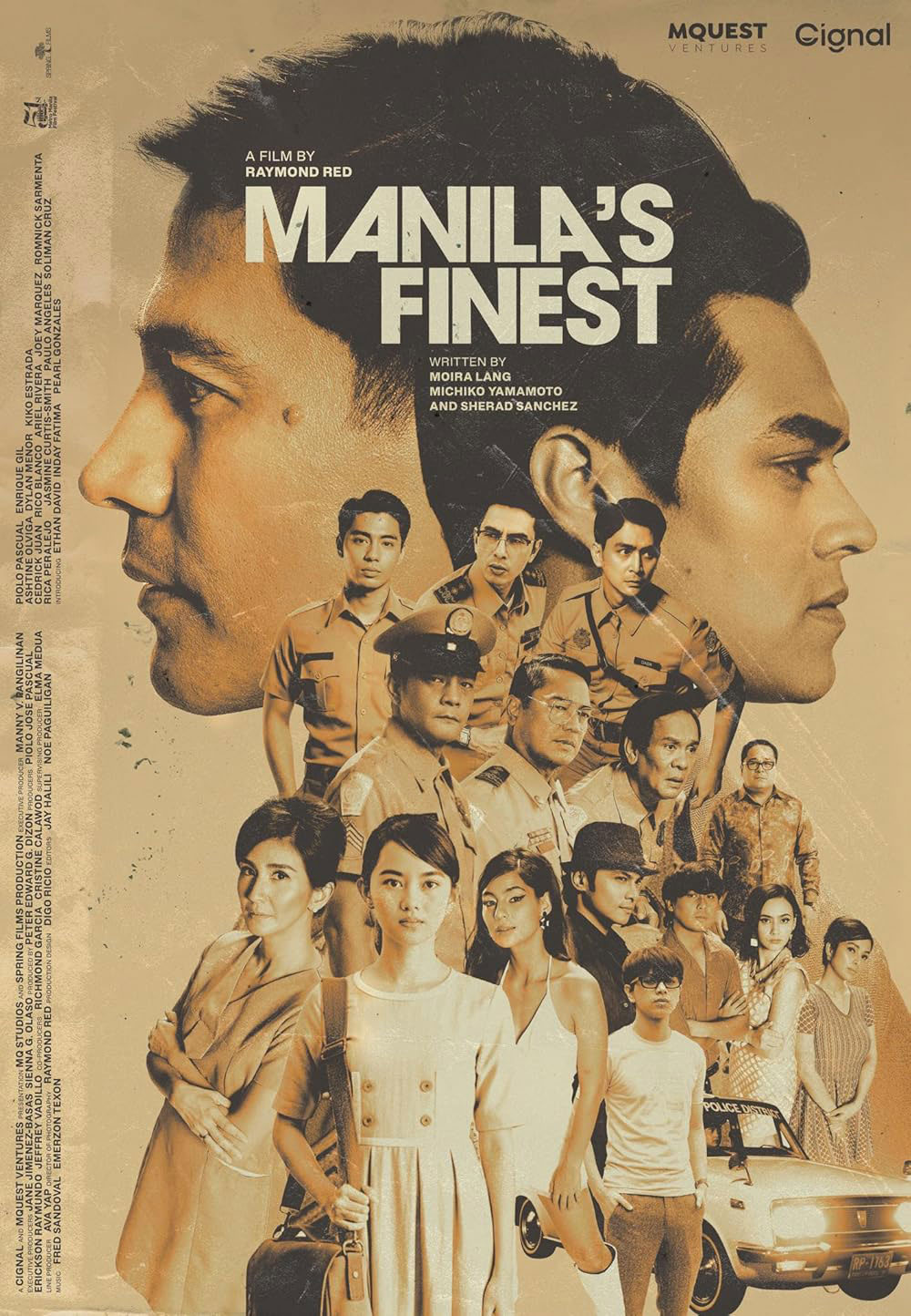 THIS HISTORICAL crime thriller revisits the sepia tones of a romanticized golden age in Philippine history with an all-star cast — and arrives at a powerfully bleak conclusion.
The picture of the late 1960s and early ’70s that we see in Manila’s Finest is what we get after Piolo Pascual’s protagonist, Capt. Homer Magtibay, peels away layers of grime and dust accumulated from years of secrecy and neglect. Ultimately, it traces the tragic downfall of those at the heart of a flawed system.
Manila’s Finest centers on Magtibay’s struggle to uphold the integrity of police work amid rapidly changing times, along with his colleagues Lt. Billy Ojeda (played by Enrique Gil), Officer Liwanag (Joey Marquez), and Officer Meneses (Romnick Sarmenta). The film opens with the four of them patrolling the streets of Manila in a squad car, listening to news of Gloria Diaz winning the Miss Universe pageant and the success of the moon landing over the car radio.
Tensions rise when they pick up a teenager coming home late from doing a school project. Though the four treat the boy well, they encounter a squad car driving in the opposite direction manned by PC MetroCom officers, which they remark would have spelled trouble for the kid.
For those who need to brush up on their history, PC MetroCom refers to the Metropolitan Command, a unit under the Philippine Constabulary created by then-president Ferdinand Marcos to supplement the local police and combat criminal activity. The film’s central conflict has these ruthless officers, led by Officer Danilo Abad (played with just enough sinister abrasiveness by Cedrick Juan), encroaching into local police operations.
Turmoil brews on both sides as they deal with growing discontent, from mediating the unstable Sputnik vs. Bahala Na gang war, to trying and failing to observe maximum tolerance during student protests at Mendiola.
To make matters worse, as Magtibay and friends dig their heels in, their level-headed station chief Major Conrado Belarmino (Ariel Rivera) exits the picture, giving way to a deplorable replacement, Epifanio Javier (played over-the-top by an almost-unrecognizable Rico Blanco).
It’s a surreal combination that brings this film to life. Raymond Red is a Cannes-winning alternative film director, and this marks his first time directing a studio film. His direction and cinematography push the story forward with a firm grasp of social realism, mixed with moody, turbulent framing and lighting choices that both convey melancholy and foretell darker times ahead. Written by Moira Lang, Michiko Yamamoto, and Sherad Sanchez, the script is imbued with hints of humor and heart, making the tragedy of the Manila police’s downfall all the more potent.
The all-star cast is what pulls audiences in, and I hope they come on board for their favorite stars but come out with a curiosity to dig deeper and reflect on this period of Philippine history.
At the special screening I was in, a big chunk of the audience was made up of fans of rising actress Ashtine Olviga, who plays Magtibay’s daughter and rebellious student activist with a compelling vitality. They would scream whenever she appeared, “awww” whenever she had a crying scene, and gasp at all the shocking moments in the film. It’s these young audience members I hope will come away most affected or at least intrigued by Manila’s Finest.
With that said, it really is a downer of a film, placing us squarely in a time period at the cusp of the point of no return. It comes at a time where revisiting history feels all the more essential, and yet seemingly nothing is learned from the lessons it offers up.
Pascual is, again, excellent in a lead role, and doubly so in this one because Magtibay is far from perfect. Though he stands for the integrity of the traditional police officer, the film does not shy away from his mistakes and flaws as the events unfold. His personal life also complicates things — and this is the part of the story that feels a bit one-note or half-baked — as he interacts with both his second wife Yolly (Rica Peralejo) and his secret lover Janette (Jasmine Curtis-Smith).
The supporting cast is solid as well. Gil as Lt. Ojeda, who wavers in loyalty as he toes the line between the Manila police and the MetroCom, holds your attention. Marquez and Sarmenta, who balance the main squad’s dynamic with witty remarks and natural exchanges, fill out the world of the police station. All of the groundwork here pays off later, when the so-called “Manila’s finest” comes to the brink of collapse.
Aside from a strong ensemble, this film is also elevated by the subtle details in production design. Each street, home, restaurant, or police station façade evokes not just fond nostalgia, but also meaningful points of evolution in the story. With a pace akin to a slow burn (at least, as far as crime thrillers go), the action feels more realistic than showy, while the music settles for kundimans played on the radio to blend with the minimal score. The costume design and hair and makeup delivered, too, with the characters definitely looking as they should for the time period.
Manila’s Finest is about a police officer investigating brutal killings and solving disappearances, yes, but it’s how his firm belief in his profession is tested as the city of Manila rapidly changes that may haunt you after the movie ends. It’s a human drama with a stellar cast that speaks to the complex identity of the Philippines — how it was back then, and how eerily similar it may be to today.