Malayo sa bituka… or so they think
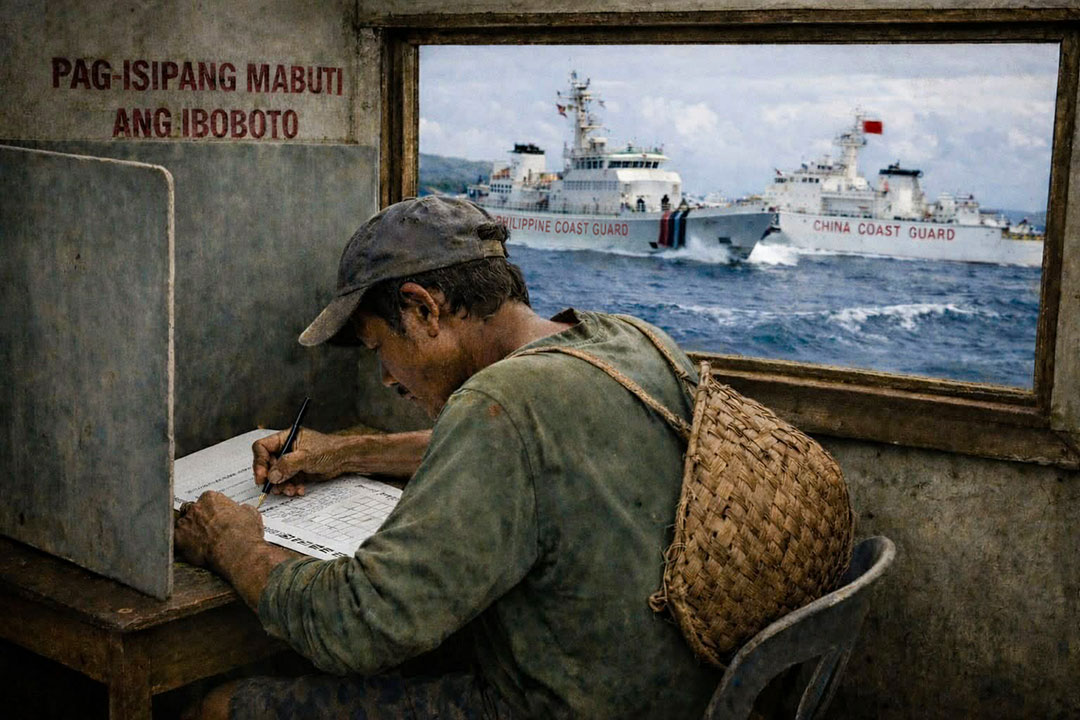
I suspect many Filipinos who struggle to make ends meet each day regard China’s coercion in the West Philippine Sea (WPS) this way: it’s hardly a gut issue.
Well, except perhaps for an estimated 300,000 fisherfolk spread across Zambales (including about 1,500 in Masinloc municipality who have completely abandoned Scarborough Shoal, which had otherwise been their traditional fishing ground for decades), Pangasinan, and Palawan who bear the brunt of harassment by China’s coast guard and maritime militia, as well as the onslaught of Chinese commercial fishing boats1.
This fact, plus almost daily accounts on Chinese naval and coast guard harassment of our fisherfolk as well as smaller coast guard and fisheries bureau ships, should have a clear effect on Filipinos’ trust in our huge neighbor. To be sure, a December 2025 survey conducted by OCTA Research showed that the majority of respondents (60%) still distrust China. But this reading was down significantly from 85% reported in July the same year2.
Given such a sharp reduction in distrust of China, as well as the continued popularity of elected officials perceived by some quarters as echoing Beijing’s arguments vs. the Philippines’ stand on the West Philippine Sea (WPS), it remains unclear just how much our tiff with China over the WPS figures in Filipinos’ choice of/support for elective officials.
Hence, anyone who wants this issue to make its mark for the 2028 presidential, legislative, and local elections will have to change current messaging on this matter.
POSTURING
Those who fear that the 2028 national election will lead to a foreign policy shift that will make it easier for China to deny us our rights to resources within our exclusive economic zone (EEZ) would hope that presidential and senatorial hopefuls deemed pro-Beijing will fail in their bids.
China itself has not been idle outside its maritime pressure campaign both at sea and on social media, with a newly seated ambassador (fresh from his four-year stint in Washington, DC) wasting no time in making the rounds of non-defense-related sectors (the latest being at the Social Welfare department to hand over a $1-million grant3) in an all-out charm offensive to win Pinoy hearts and minds.
The choice of this “America hand” at this time makes sense as Chinese President Xi Jinping’s perceived window for retaking Taiwan (by various means) between 2027 (the centenary of the People’s Liberation Army) and 2049 (the 100th year of the People’s Republic of China)4 draws near and political positioning and posturing heats up towards our May 2028 national election. Those polls are a rare opportunity to prod a Philippine foreign policy reset which Beijing cannot ignore.
Those wary of perceived pro-China politicians among us will do well to heed the results of various surveys last year showing that economic issues top Filipinos’ concerns, particularly rising prices of goods and services, cost of living, job creation, better access to education, corruption, etc.5. Anything related to WPS is nowhere on the list.
These findings are consistent with:
• separate results showing that more than half of respondents of a November 2025 Social Weather Stations survey rated themselves poor6, and that more than a fifth said that they went hungry involuntarily “at least once in the past three months”7;
• as well as estimates that socioeconomic classes D and E make up about 78% and 14%, respectively, of the country’s registered voters, while ABC folks (mostly C) share what’s left8.
That’s the public that needs to be convinced that standing up to China in defense of our maritime rights is a gut household issue, if those pushing for continuation of a strong stand for our WPS rights beyond 2028 were to have their way.
RECALIBRATION
How does one do that?
Offhand, making the WPS a household issue can focus on three concerns: affordable, available fish and other seafood for the table; jobs; as well as affordable, sufficient electricity.
• Food. Do you notice how some of us downplay arguments on principle by replying “Hindi naman nakakain ’yan (that cannot be eaten).” Well in this case, I disagree. Fish accounts for over a fifth of protein and some 11.7% of total food intake in a typical Filipino diet9. That’s how crucial fish is to us.
The South China Sea (SCS), of which the West Philippine Sea forms part, accounts for about 22% of the world’s fish species. Its coral reefs support about 3,790 species of fish. It is home to fish and other edible marine species such as anchovies, barracuda, crabs, crayfish, cuttlefish, hairtail, mackerel, pomfret, prawns, sardines, scad, sea bream, shrimp, snapper, squid, tuna, various bivalves, and seaweed10.
The SCS accounts for about a third of the Philippines’ fish production, while the WPS supplies a little bit more than a tenth of Philippine “capture fisheries” (a category covering both municipal — or up to 15 kilometers from the shore — and commercial fishing), according to experts at the December 2025 conference, “Eyes on the Sea: Community-Based Maritime Monitoring and Reporting in the West Philippine Sea,” held at the Manila Polo Club in Makati City. The Bureau of Fisheries and Aquatic Resources’ (BFAR) Philippine Fisheries Profile 2020 showed that municipal capture fisheries accounted for more than a fifth of the country’s fish production, while more than a third came from commercial capture fisheries11.
• Jobs. Then you have families affected by China’s attempt to keep us out of our traditional fishing grounds (and to allow us in only after conceding that the area under its sovereignty).
BFAR’s Philippine Fisheries Profile 2022 showed that there were some 2.3 million individuals involved in various stages of fish production, e.g., capture fishing, aquaculture, fish gleaning, fish vending, fish processing, etc., of which about 1.173 million (50.96%) were engaged in capture fishery and 259,448 (11.27%) were into aquaculture12.
The 300,000 fishers (including Masinloc’s 1,500) affected by China’s coercion in the WPS may be just a tenth of nationwide fisherfolk, but the impact of that segment of this sector widens if one were to include their social networks and the public optics of their plight.
It is distressing to read accounts of how families affected by the dwindling fish catch over the past two decades (due also to encroaching Chinese, Taiwanese, and Vietnamese commercial fishers as well as environment changes, but aggravated by Chinese armed harassment since 2012) have tried to make ends meet despite few alternative options13.
Hence, the government needs to go beyond providing free food and fuel to fishermen sailing into harm’s way by offering alternative livelihood for their families and even scholarships for their deserving kids (e.g., in marine sciences, fisheries, aquaculture, agribusiness, or other relevant courses). It needs to be more proactive and creative here in order to avoid a repeat of those instances wherein it failed to provide well-studied, well-designed, realistic, and sufficient alternatives for those affected, for example, by changes in policy, e.g., the sudden, temporary closure of Boracay to tourism in April 2018, and the modernization program for public utility jeepneys that began in 2017.
• Electricity. With the Malampaya natural gas-oil field within our EEZ — it supplies about a fourth of the country’s energy needs — about to run dry in the next two to three years (the much-vaunted new digs there will add just a few years of supply), we face the looming prospect of hours-long power outages reminiscent of the problem that hit us in the 1990s14 as well as much-higher electricity and pump prices due to having to import more fuel in order to bridge the bigger supply-consumption gap.
Hence the urgent need to dig elsewhere.
That leads us to Reed Bank (also called Recto Bank) which we have refrained from exploring due to Beijing’s threat (well, Malaysia went ahead with its own similar plan anyway despite pressure from China15). Early in his term, former president Rodrigo R. Duterte recalled that Chinese President Xi Jinping, when the former voiced the need to explore for new energy sources in the South China Sea, warned him: “We’re friends… but if you force the issue, we’ll go to war16.”
The Reed Bank’s potential natural gas and oil reserves have been estimated at 55.1 trillion cubic feet (TcF) and 5.4 billion barrels, respectively, compared to Malampaya’s 2.7-3.3 TcF and at least 85 million barrels, respectively.17 This means Reed Bank could hold nearly a third of total estimated natural gas and close to half of the oil in the South China Sea, since the US Energy Information Agency has estimated that the SCS holds about 190 TcF of natural gas and 11 billion barrels of oil18.
Hence, the need to find ways to finally proceed with that potential dig, where initial exploration took place in the 1970s and which Forum Energy Ltd. acquired as a concession in 2005. Forum Energy (whose ultimate parent, First Pacific Co. Ltd., is related to BusinessWorld via PLDT Inc.) initiated surveys in 2011 which were disrupted by Chinese ships19.
TARGET AUDIENCE
Finally, there is a need to change the mode of messaging in order to reach a wider public.
China understands this only too well.
Soon after China’s new ambassador took his post in December, the Beijing-based China Radio International (the international radio arm of the China Media Group that is under the Chinese Communist Party’s Publicity Department) pushed its CRI Filipino Service more aggressively to amplify propaganda in Tagalog (and, presumably, later on in other dialects) largely through its Facebook page (https://tinyurl.com/2dt6t2sb).
I would expect that Beijing has already been reaching out to much of the population via other social media platforms, and the only reason that many of us do not see its messages is that we are not covered/included in the algorithm used for this purpose. We are simply not the audience for some of its messages.
Expect such targeting to become sharper with more skillful use of artificial intelligence towards next year.
Those countering Beijing’s WPS propaganda can do no less and need to target and execute messaging better and smarter.
So, by all means: continue and improve our maritime transparency initiative, which has succeeded in drawing support from both neighbors and allies in the West. Beijing has long opposed any move to draw in other interested parties, because it is easier to coopt a smaller party like the Philippines that stands alone.
But the time has come to sharpen the focus on the WPS issues affecting the wider population, and this could be one way to go.
Take it from an ordinary citizen.
Notes:
1 https://tinyurl.com/m2cf256p
https://tinyurl.com/336h8bms
2 https://tinyurl.com/et8trdpm
3 https://tinyurl.com/4shkxn47
4 https://tinyurl.com/5dt2mec4
5 https://tinyurl.com/yhu6j6k2
https://tinyurl.com/39572xjb
https://tinyurl.com/48b99c6y
https://tinyurl.com/bdvptdx9
6 https://tinyurl.com/msupbj64
7 https://tinyurl.com/5k4u5vp9
8 https://tinyurl.com/39n3ydvt
9 https://tinyurl.com/yamptwy3
https://tinyurl.com/2ucjawpx
https://tinyurl.com/2drnxtmt
10 https://tinyurl.com/bk67vy8z
11 https://tinyurl.com/4wtx65ca
12 https://tinyurl.com/24swhmde
13 https://tinyurl.com/5akhwv7x
14 https://tinyurl.com/59kfhye9
15 https://tinyurl.com/59h8m238
16 https://tinyurl.com/ycy73ubd
17 https://tinyurl.com/3fnye5mk
18 https://tinyurl.com/yv59a5dd
https://tinyurl.com/4rf24vye
19 https://tinyurl.com/yc4yd3v9
Wilfredo G. Reyes was editor-in-chief of BusinessWorld from 2020 through 2023.